
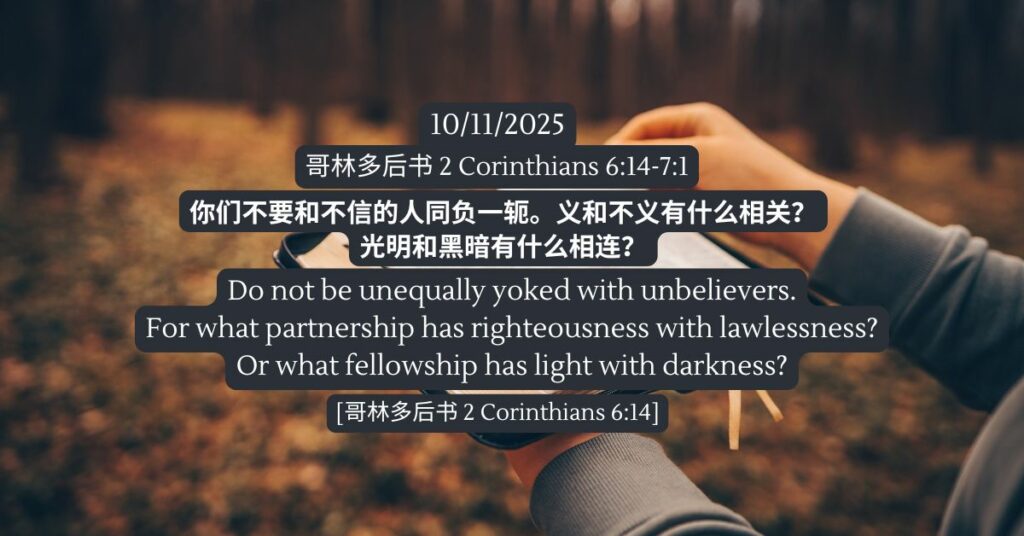
2 Corinthians 6:14-7:1
Do not be unequally yoked with unbelievers. For what partnership has righteousness with lawlessness? Or what fellowship has light with darkness? – 2 Corinthians 6:14
Click to read
The verse, “Do not be unequally yoked with unbelievers” (v.14), is often quoted in teachings about marriage, but Paul’s intent goes far beyond that. In this passage, he is speaking about how believers are to live holy and set-apart lives in a world filled with idolatry and worldly values.
Paul uses five contrasts to describe the difference between believers and unbelievers: “righteousness vs. lawlessness,” “light vs. darkness,” “Christ vs. Belial (a name for Satan),” “believer vs. unbeliever,” and “the temple of God vs. idols.” These contrasts highlight that the deepest distinction lies in the centre, or foundation, of one’s life. For believers, the foundation is Christ; for unbelievers, it is the self, the world, or other idols.
When two lives built on different foundations are “yoked together,” it is like two oxen pulling in opposite directions, which would lead to both ending up hurt. When our values, goals, and loyalties are completely different yet forced to move together, tension and compromise are inevitable.
For example, when a believer works closely with someone who does not value integrity, it becomes a struggle to stay honest when profits are at stake. In marriage, when one spouse follows Christ and the other does not, differences in faith can deeply affect parenting and the family’s moral framework. This is not a condemnation, but a recognition of the real challenges that such differences bring.
“Therefore go out from their midst, and be separate from them, says the Lord.” (v.17)
To “be separate” does not mean to avoid contact with the world. Jesus Himself ate with tax collectors and sinners, yet He was never defiled by them. Instead, He brought holiness and love into their lives.
We are called to live in the world, but not of it. We can build friendships and work alongside those who do not share our faith, but we must remember who we are and where our boundaries lie. We are not called to be influenced by the world, but to influence it by being salt and light.
For example, when we attend workplace gatherings, we can be friendly and open without compromising our faith. In conversations, we can listen and understand without surrendering the truth. When people see our integrity, gentleness, humility, and reverence for God, they will see the light of Christ through us.
Paul reminds us, “For we are the temple of the living God; as God said, ‘I will make my dwelling among them and walk among them.’” (v.16) This is the heart of the passage, that our ability to live holy lives does not come from moral superiority, but from God’s presence within us. His indwelling presence gives us the power to say “no” to sin and the courage to love others well.
If we talk about “separation” without God’s presence, we risk becoming proud, judgmental, or cold. True wisdom lies in engaging with the world without being tainted by it, and in moving among people in the world while remaining faithful to our God.
Reflection:
Have I ever compromised my faith out of fear of rejection or the desire to fit in? How can I make choices in my work, relationships, family, or friendships, to show both love and conviction?
Prayer:
Lord, thank You for calling me to be Your dwelling place. Grant me wisdom to walk among unbelievers without fear or compromise. Teach me to live a holy life that shines with Your light and love, so that others may see You in me. In Jesus’ name I pray, amen.
Click to read
The verse, “Do not be unequally yoked with unbelievers” (v.14), is often quoted in teachings about marriage, but Paul’s intent goes far beyond that. In this passage, he is speaking about how believers are to live holy and set-apart lives in a world filled with idolatry and worldly values.
Paul uses five contrasts to describe the difference between believers and unbelievers: “righteousness vs. lawlessness,” “light vs. darkness,” “Christ vs. Belial (a name for Satan),” “believer vs. unbeliever,” and “the temple of God vs. idols.” These contrasts highlight that the deepest distinction lies in the centre, or foundation, of one’s life. For believers, the foundation is Christ; for unbelievers, it is the self, the world, or other idols.
When two lives built on different foundations are “yoked together,” it is like two oxen pulling in opposite directions, which would lead to both ending up hurt. When our values, goals, and loyalties are completely different yet forced to move together, tension and compromise are inevitable.
For example, when a believer works closely with someone who does not value integrity, it becomes a struggle to stay honest when profits are at stake. In marriage, when one spouse follows Christ and the other does not, differences in faith can deeply affect parenting and the family’s moral framework. This is not a condemnation, but a recognition of the real challenges that such differences bring.
“Therefore go out from their midst, and be separate from them, says the Lord.” (v.17)
To “be separate” does not mean to avoid contact with the world. Jesus Himself ate with tax collectors and sinners, yet He was never defiled by them. Instead, He brought holiness and love into their lives.
We are called to live in the world, but not of it. We can build friendships and work alongside those who do not share our faith, but we must remember who we are and where our boundaries lie. We are not called to be influenced by the world, but to influence it by being salt and light.
For example, when we attend workplace gatherings, we can be friendly and open without compromising our faith. In conversations, we can listen and understand without surrendering the truth. When people see our integrity, gentleness, humility, and reverence for God, they will see the light of Christ through us.
Paul reminds us, “For we are the temple of the living God; as God said, ‘I will make my dwelling among them and walk among them.’” (v.16) This is the heart of the passage, that our ability to live holy lives does not come from moral superiority, but from God’s presence within us. His indwelling presence gives us the power to say “no” to sin and the courage to love others well.
If we talk about “separation” without God’s presence, we risk becoming proud, judgmental, or cold. True wisdom lies in engaging with the world without being tainted by it, and in moving among people in the world while remaining faithful to our God.
Reflection:
Have I ever compromised my faith out of fear of rejection or the desire to fit in? How can I make choices in my work, relationships, family, or friendships, to show both love and conviction?
Prayer:
Lord, thank You for calling me to be Your dwelling place. Grant me wisdom to walk among unbelievers without fear or compromise. Teach me to live a holy life that shines with Your light and love, so that others may see You in me. In Jesus’ name I pray, amen.