
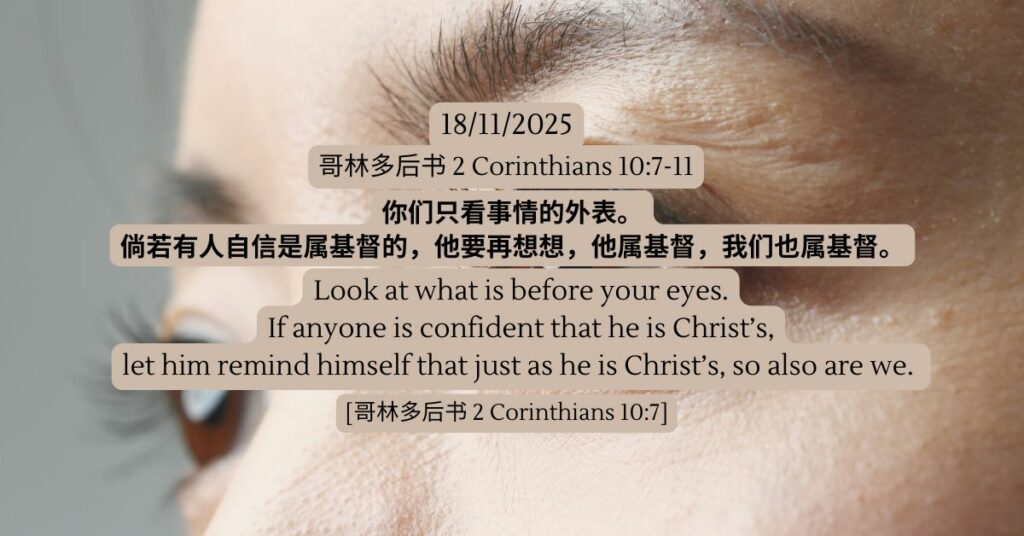
2 Corinthians 10:7-11
Look at what is before your eyes. If anyone is confident that he is Christ’s, let him remind himself that just as he is Christ’s, so also are we. – 2 Corinthians 10:7
Click to Read
Growing up, there was an old man in my neighbourhood whose regular attire was a worn-out singlet and a pair of faded short pants. Every morning, he would carry a basket, don his wooden clogs and walk past where I stayed. People who did not know him could not be faulted for thinking he was a poor old man. Not for us because we knew he owned what was then one of the biggest envelope-making companies in Singapore. And what he carried in his basket were hard cash to be deposited in the bank.
Despite knowing it is unwise to judge a book by its cover, many of us still make the mistake of misjudging people by their appearance. Even the prophet Samuel made the same mistake. When God sent him to the house of Jesse to look for Saul’s successor, he saw Jesse’s eldest son and thought that must be the man God was looking for. But God said to him, “Do not consider his appearance or his height, for I have rejected him. The LORD does not look at the things people look at. People look at the outward appearance, but the LORD looks at the heart.” (1 Samuel 16:7).
In our text, Paul was defending himself from baseless attacks by some Corinthian believers. They questioned the authenticity of his apostleship, claiming while his letters were “weighty and forceful”, yet in person he was “unimpressive” and his words “amount to nothing”. One commentator suggests that his critics were in fact likening Paul to a timid dog who covers up his timidity by barking loudly from afar.
Due to their pride and prejudice they made two serious mistakes. First, they fired away without validating their facts. Had they checked with those who knew and had worked with Paul, they would have known Paul was not what they called him out to be. For instance, had they heard about Paul’s speech before the philosophers in Athens recorded in Acts 17, their claim that he was “unimpressive” and his words “amount to nothing” would ring hollow.
Second, they suffered from self-inflicted myopia. In Matthew 7:3, the Lord asked, “Why do you look at the speck of sawdust in your brother’s eye and pay no attention to the plank in your own eye?” Driven by pride and prejudice, these Corinthian believers were quick to criticise Paul but failed to examine themselves.
Paul, on the other hand, despite being maligned did not retaliate. Neither did he call upon God’s protection; after all in Numbers 12 God caused Miriam to become leprous after she and Aaron criticised Moses and challenged his authority. It is said the test of a leader is in his or her use of power. Paul was clear that the authority vested in Him was for building up rather than tearing the church as he reasoned with his critics firmly and lovingly.
Reflections:
1. Why is it unwise to judge people by their appearance?
2. Think of an instance you had done that. What would you do differently the next time?
3. Based on Paul’s response to his critics, how should we react when we are unjustly criticised?
Prayer:
Lord, thank you for reminding us to do unto others what we want others to do to us. Please forgive us for any critical spirit we have consciously or unconsciously nurtured in our hearts and replace it with the love of Christ that builds up others and brings healing to the world around us, for the sake of your glory. In Jesus’ most precious Name we pray. Amen.
Click to Read
Growing up, there was an old man in my neighbourhood whose regular attire was a worn-out singlet and a pair of faded short pants. Every morning, he would carry a basket, don his wooden clogs and walk past where I stayed. People who did not know him could not be faulted for thinking he was a poor old man. Not for us because we knew he owned what was then one of the biggest envelope-making companies in Singapore. And what he carried in his basket were hard cash to be deposited in the bank.
Despite knowing it is unwise to judge a book by its cover, many of us still make the mistake of misjudging people by their appearance. Even the prophet Samuel made the same mistake. When God sent him to the house of Jesse to look for Saul’s successor, he saw Jesse’s eldest son and thought that must be the man God was looking for. But God said to him, “Do not consider his appearance or his height, for I have rejected him. The LORD does not look at the things people look at. People look at the outward appearance, but the LORD looks at the heart.” (1 Samuel 16:7).
In our text, Paul was defending himself from baseless attacks by some Corinthian believers. They questioned the authenticity of his apostleship, claiming while his letters were “weighty and forceful”, yet in person he was “unimpressive” and his words “amount to nothing”. One commentator suggests that his critics were in fact likening Paul to a timid dog who covers up his timidity by barking loudly from afar.
Due to their pride and prejudice they made two serious mistakes. First, they fired away without validating their facts. Had they checked with those who knew and had worked with Paul, they would have known Paul was not what they called him out to be. For instance, had they heard about Paul’s speech before the philosophers in Athens recorded in Acts 17, their claim that he was “unimpressive” and his words “amount to nothing” would ring hollow.
Second, they suffered from self-inflicted myopia. In Matthew 7:3, the Lord asked, “Why do you look at the speck of sawdust in your brother’s eye and pay no attention to the plank in your own eye?” Driven by pride and prejudice, these Corinthian believers were quick to criticise Paul but failed to examine themselves.
Paul, on the other hand, despite being maligned did not retaliate. Neither did he call upon God’s protection; after all in Numbers 12 God caused Miriam to become leprous after she and Aaron criticised Moses and challenged his authority. It is said the test of a leader is in his or her use of power. Paul was clear that the authority vested in Him was for building up rather than tearing the church as he reasoned with his critics firmly and lovingly.
Reflections:
1. Why is it unwise to judge people by their appearance?
2. Think of an instance you had done that. What would you do differently the next time?
3. Based on Paul’s response to his critics, how should we react when we are unjustly criticised?
Prayer:
Lord, thank you for reminding us to do unto others what we want others to do to us. Please forgive us for any critical spirit we have consciously or unconsciously nurtured in our hearts and replace it with the love of Christ that builds up others and brings healing to the world around us, for the sake of your glory. In Jesus’ most precious Name we pray. Amen.