
Isaiah 41:8-20
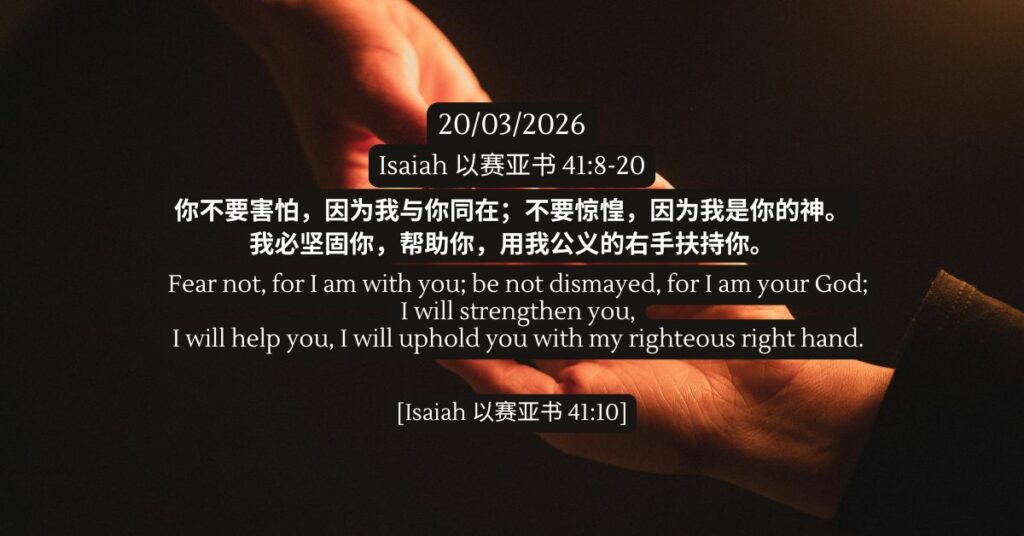
Fear not, for I am with you; be not dismayed, for I am your God;I will strengthen you, I will help you, I will uphold you with my righteous right hand. – Isaiah 41:10
Click to read passage
When we read the book of Numbers and reflect on Israel’s journey out of Egypt, we see a recurring pattern of trouble. The people repeatedly sinned and rebelled, yet experienced both the judgment and the mercy of the LORD.
Numbers 16 to 19 records a major rebellion led by leaders among the Levites, who challenged the authority God had given to Moses as leader and to Aaron as high priest. The LORD confirmed Aaron’s priesthood through the budding staff, while judging the leaders of the rebellion and their households. When the people complained that Moses had caused their deaths, the anger of the LORD broke out against them. A plague struck the rebellious people, but through the intercession of Moses and Aaron, God delivered Israel from death.
To help the people deal with the ongoing problem of sin, God reaffirmed two important responsibilities for the priests. First, the priests and Levites were to guard the tabernacle, so that the people would not die by coming too close to the holiness of God. Second, the priests were instructed to burn a red heifer and use its ashes mixed with water to cleanse those who had become unclean through contact with a dead body (Numbers 19). This pointed to the truth that the impurity of sin must be removed through the shedding of blood. As it is written, “without the shedding of blood there is no forgiveness of sins” (Hebrews 9:22). Thus, the red heifer points to the sacrifice of Jesus Christ, whose blood cleanses all who believe in Him.
Though the people were faithless, God remains faithful. Through the prophet Isaiah, God said to Israel, “You are my servant, I have chosen you and not cast you off” (Isaiah 41:9).
God’s calling is unchanging. From the beginning to the end of the world, although His servants may be weak and may fail, He does not reject them. From the moment Adam and Eve fell, God’s plan of redemption was already in motion. His desire is to deliver humanity from the power of sin and death.
By the later period of Isaiah’s ministry, the northern kingdom had already been taken captive by Assyria, and Judah would soon be exiled to Babylon. In such a dark time, did God’s people still have a future? Would the covenant with David still stand?
Yet through the prophet, God brings comfort to His people: “Fear not, for I am with you” (Isaiah 41:10).
Even though Israel was as weak as a worm, they were told, “Fear not… I am the one who helps you… your Redeemer is the Holy One of Israel” (Isaiah 41:14).
God’s power is made perfect in human weakness. He Himself will uphold and help His people, “that they may see and know, may consider and understand together, that the hand of the LORD has done this, the Holy One of Israel has created it” (Isaiah 41:20).
God’s promises never change. Through the life, death, and resurrection of Jesus Christ, His plan of redemption has been fully accomplished.
Today, through Jesus Christ, God’s chosen people are no longer limited to one individual or one nation but include people from every tribe and nation. Because His calling never changes, no matter our present condition, if we come before Him, the love shown on the cross can carry our weaknesses, remove our shortcomings, and reshape us. Through the power of the Holy Spirit, we become a new people who live in a way that pleases God.
Reflection:
What is the Holy Spirit saying to you today through this passage in Isaiah? As children of God, what are you most afraid of? Let us turn our eyes away from our circumstances and fix them on God. His promises never change.
Prayer:
Thank You, Lord Jesus, for Your unfailing love. Though we are weak and fall short, Your love never changes. Help me, by the power of the Holy Spirit, to live out Your holy character. Fill my heart with hope, that I may live in Your promises. I pray in the precious name of the Lord Jesus Christ, Amen.
Click to read passage
When we read the book of Numbers and reflect on Israel’s journey out of Egypt, we see a recurring pattern of trouble. The people repeatedly sinned and rebelled, yet experienced both the judgment and the mercy of the LORD.
Numbers 16 to 19 records a major rebellion led by leaders among the Levites, who challenged the authority God had given to Moses as leader and to Aaron as high priest. The LORD confirmed Aaron’s priesthood through the budding staff, while judging the leaders of the rebellion and their households. When the people complained that Moses had caused their deaths, the anger of the LORD broke out against them. A plague struck the rebellious people, but through the intercession of Moses and Aaron, God delivered Israel from death.
To help the people deal with the ongoing problem of sin, God reaffirmed two important responsibilities for the priests. First, the priests and Levites were to guard the tabernacle, so that the people would not die by coming too close to the holiness of God. Second, the priests were instructed to burn a red heifer and use its ashes mixed with water to cleanse those who had become unclean through contact with a dead body (Numbers 19). This pointed to the truth that the impurity of sin must be removed through the shedding of blood. As it is written, “without the shedding of blood there is no forgiveness of sins” (Hebrews 9:22). Thus, the red heifer points to the sacrifice of Jesus Christ, whose blood cleanses all who believe in Him.
Though the people were faithless, God remains faithful. Through the prophet Isaiah, God said to Israel, “You are my servant, I have chosen you and not cast you off” (Isaiah 41:9).
God’s calling is unchanging. From the beginning to the end of the world, although His servants may be weak and may fail, He does not reject them. From the moment Adam and Eve fell, God’s plan of redemption was already in motion. His desire is to deliver humanity from the power of sin and death.
By the later period of Isaiah’s ministry, the northern kingdom had already been taken captive by Assyria, and Judah would soon be exiled to Babylon. In such a dark time, did God’s people still have a future? Would the covenant with David still stand?
Yet through the prophet, God brings comfort to His people: “Fear not, for I am with you” (Isaiah 41:10).
Even though Israel was as weak as a worm, they were told, “Fear not… I am the one who helps you… your Redeemer is the Holy One of Israel” (Isaiah 41:14).
God’s power is made perfect in human weakness. He Himself will uphold and help His people, “that they may see and know, may consider and understand together, that the hand of the LORD has done this, the Holy One of Israel has created it” (Isaiah 41:20).
God’s promises never change. Through the life, death, and resurrection of Jesus Christ, His plan of redemption has been fully accomplished.
Today, through Jesus Christ, God’s chosen people are no longer limited to one individual or one nation but include people from every tribe and nation. Because His calling never changes, no matter our present condition, if we come before Him, the love shown on the cross can carry our weaknesses, remove our shortcomings, and reshape us. Through the power of the Holy Spirit, we become a new people who live in a way that pleases God.
Reflection:
What is the Holy Spirit saying to you today through this passage in Isaiah? As children of God, what are you most afraid of? Let us turn our eyes away from our circumstances and fix them on God. His promises never change.
Prayer:
Thank You, Lord Jesus, for Your unfailing love. Though we are weak and fall short, Your love never changes. Help me, by the power of the Holy Spirit, to live out Your holy character. Fill my heart with hope, that I may live in Your promises. I pray in the precious name of the Lord Jesus Christ, Amen.