
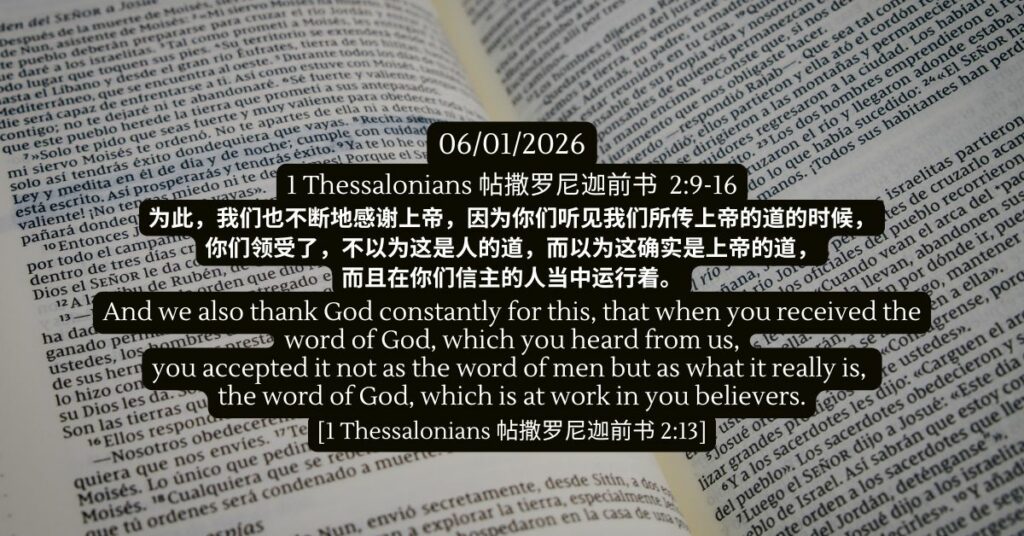
1 Thessalonians 2:9-16
And we also thank God constantly for this, that when you received the word of God, which you heard from us, you accepted it not as the word of men but as what it really is, the word of God, which is at work in you believers. – 1 Thessalonians 2:13
Click to read passage
Being misunderstood or falsely accused is one of the more painful experiences we may face in life. Few things are more complex than trying to do good with sincere motives, only to be met with suspicion, slander, or criticism. In moments like these, it is natural to want to withdraw—to hide from the noise and seek refuge where no one can reach us.
The passage before us today speaks directly to those who find themselves in such situations. To understand this, it is helpful to review what Paul has written so far in 1 Thessalonians. In chapter 1, Paul commends the faith of the young Thessalonian church, remembering their work of faith, labour of love, and patience of hope (1 Thess 1:3), even though the church had been established for less than a year. Then, in 1 Thessalonians 2:1–8, Paul defends the sincerity and integrity of his ministry, message, and motives, despite his earlier troubles in Philippi. Verse 8 is particularly striking: “So being affectionately desirous of you, we were willing to impart to you not only the gospel of God but also our own lives, because you had become very dear to us.” (KJV)
1 Thess 2:9-13 then goes on to describe Paul’s own behaviour and attitude while he was in Thessalonica. While Paul recognized the right to support by those he ministered to (e.g. 1 Cor 9:14), here he clearly took a “higher” standard of supporting himself, labouring day and night, because he did not want to trouble the Thessalonians for his daily needs, while yet still preaching the gospel daily (v.9). He reminded the Thessalonians how “holy, righteous and blameless” he and his team had behaved, and dealt with them “as a father deals with his own children”, encouraging, comforting and urging (vv.10-12). Paul and team also express their joy and thanks to God continually as they see the effect the word of God is having on these new believers.
Verses 14 to 16 suggest that the fact that a wondrous and positive church had been established is all the more amazing. The church in Thessalonica was established amid suffering, persecution, and hostility, as were the churches in Judea. The church had suffered (v.14), experienced hostility (v.15), and had Paul and Silas driven out against their wishes (v.15). One description of such persecution can be found in Acts 17:5-9, where the mob took action against Jason, who had housed Paul and Silas.
As I reflect on this passage, one central question emerges: how would I respond if I were to face persecution? In Singapore, where direct persecution is still uncommon, the question may take subtler forms—how do I respond to adversity, misunderstanding, or false accusation, even when I have acted with sincerity?
Both Paul and the Thessalonian believers offer instructive examples. Despite suffering, Paul remained steadfast and continued serving, not only in Thessalonica but throughout his second missionary journey. The Thessalonian church, likewise, continued to allow God’s word to work deeply in them, even though doing so brought real cost and trouble to themselves and their families, as seen in the experience of Jason in Acts 17. The question for me, then, is whether I would be willing to stand up for Jesus or retreat into a more passive and withdrawn faith. The Thessalonians clearly received the gospel as God’s message, not merely a human one—and that conviction shaped the way they responded.
Prayer:
Father, I thank you for Paul’s excellent example of persevering despite being misunderstood and falsely accused. Thank you for his great passion for your message and ministry. Help us appropriate the same power and encouragement that Paul did when we face similar circumstances today. Also, thank you for the Gospel message. It is the only hope that I have for my sinful nature in this life. Help me see that it is clearly a message from You, the creator of all things, and not from my pastors, leaders, or friends. Help me to receive it as such, just as the Thessalonian church has appropriately shown. I thank you that through the Gospel, in faith, I can claim your help as I face life’s challenges. In Jesus’ name, we pray. Amen.
Click to read passage
Being misunderstood or falsely accused is one of the more painful experiences we may face in life. Few things are more complex than trying to do good with sincere motives, only to be met with suspicion, slander, or criticism. In moments like these, it is natural to want to withdraw—to hide from the noise and seek refuge where no one can reach us.
The passage before us today speaks directly to those who find themselves in such situations. To understand this, it is helpful to review what Paul has written so far in 1 Thessalonians. In chapter 1, Paul commends the faith of the young Thessalonian church, remembering their work of faith, labour of love, and patience of hope (1 Thess 1:3), even though the church had been established for less than a year. Then, in 1 Thessalonians 2:1–8, Paul defends the sincerity and integrity of his ministry, message, and motives, despite his earlier troubles in Philippi. Verse 8 is particularly striking: “So being affectionately desirous of you, we were willing to impart to you not only the gospel of God but also our own lives, because you had become very dear to us.” (KJV)
1 Thess 2:9-13 then goes on to describe Paul’s own behaviour and attitude while he was in Thessalonica. While Paul recognized the right to support by those he ministered to (e.g. 1 Cor 9:14), here he clearly took a “higher” standard of supporting himself, labouring day and night, because he did not want to trouble the Thessalonians for his daily needs, while yet still preaching the gospel daily (v.9). He reminded the Thessalonians how “holy, righteous and blameless” he and his team had behaved, and dealt with them “as a father deals with his own children”, encouraging, comforting and urging (vv.10-12). Paul and team also express their joy and thanks to God continually as they see the effect the word of God is having on these new believers.
Verses 14 to 16 suggest that the fact that a wondrous and positive church had been established is all the more amazing. The church in Thessalonica was established amid suffering, persecution, and hostility, as were the churches in Judea. The church had suffered (v.14), experienced hostility (v.15), and had Paul and Silas driven out against their wishes (v.15). One description of such persecution can be found in Acts 17:5-9, where the mob took action against Jason, who had housed Paul and Silas.
As I reflect on this passage, one central question emerges: how would I respond if I were to face persecution? In Singapore, where direct persecution is still uncommon, the question may take subtler forms—how do I respond to adversity, misunderstanding, or false accusation, even when I have acted with sincerity?
Both Paul and the Thessalonian believers offer instructive examples. Despite suffering, Paul remained steadfast and continued serving, not only in Thessalonica but throughout his second missionary journey. The Thessalonian church, likewise, continued to allow God’s word to work deeply in them, even though doing so brought real cost and trouble to themselves and their families, as seen in the experience of Jason in Acts 17. The question for me, then, is whether I would be willing to stand up for Jesus or retreat into a more passive and withdrawn faith. The Thessalonians clearly received the gospel as God’s message, not merely a human one—and that conviction shaped the way they responded.
Prayer:
Father, I thank you for Paul’s excellent example of persevering despite being misunderstood and falsely accused. Thank you for his great passion for your message and ministry. Help us appropriate the same power and encouragement that Paul did when we face similar circumstances today. Also, thank you for the Gospel message. It is the only hope that I have for my sinful nature in this life. Help me see that it is clearly a message from You, the creator of all things, and not from my pastors, leaders, or friends. Help me to receive it as such, just as the Thessalonian church has appropriately shown. I thank you that through the Gospel, in faith, I can claim your help as I face life’s challenges. In Jesus’ name, we pray. Amen.