
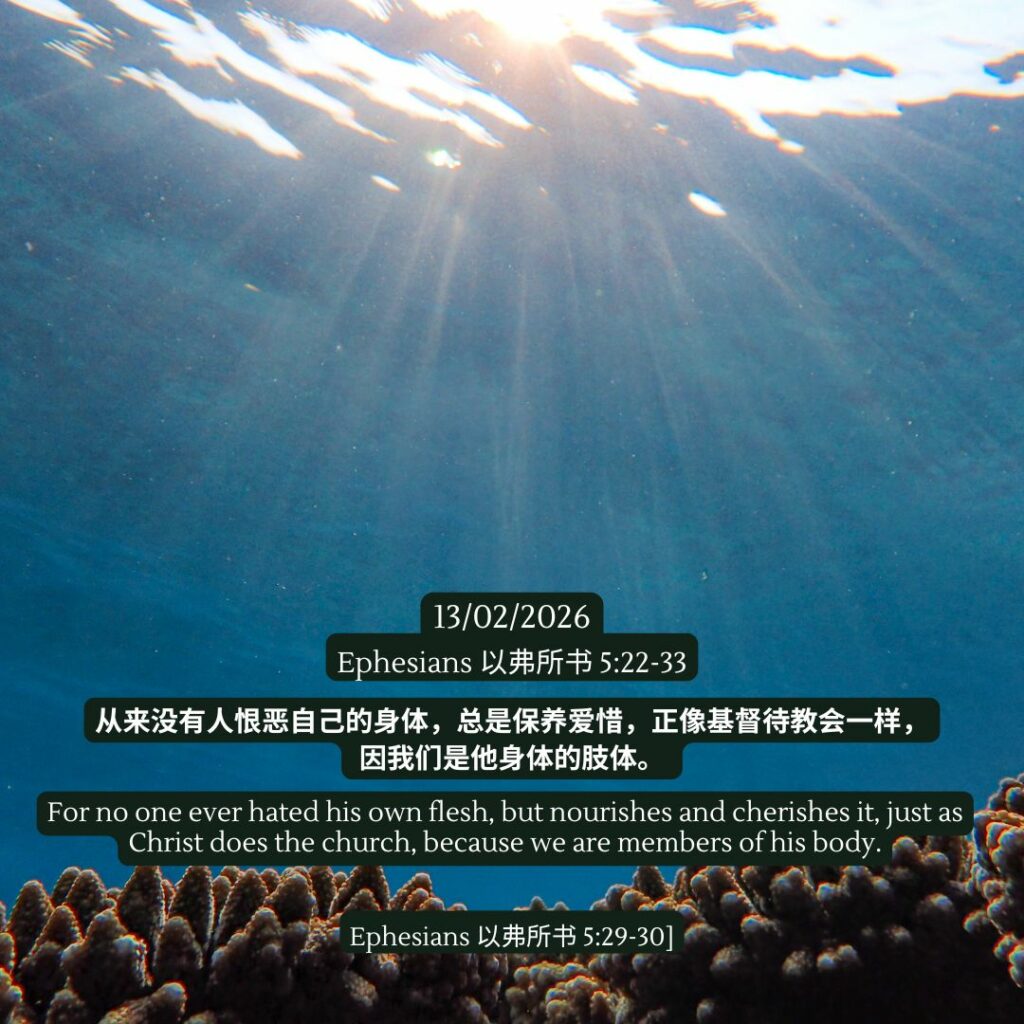
Ephesians 5:22-33
For no one ever hated his own flesh, but nourishes and cherishes it, just as Christ does the church, because we are members of his body. – Ephesians 5:29-30
Click to read passage
Earlier this week, we saw in Numbers 5-6, God’s deep concern for the holiness of His people. Sin, impurity, and broken relationships cannot simply be ignored because God, who is holy, desires to dwell among His people. The camp of Israel was to be kept clean, relationships were to be made right, and those specially set apart were to live lives of visible devotion. The section ends with the Priestly Blessing (Numbers 6:22–27), reminding us that the holiness of God’s people is not sustained by human effort alone, but flows from God’s grace.
Numbers 5-6 also exposes a tension for God’s people. Even with clear laws, careful procedures, and strong boundaries, God’s people still struggled with sin. The question remains, how will God’s people ever become truly and completely holy?
Ephesians 5 points us to God’s ultimate answer. After the Lord Jesus rose from the dead and ascended to heaven, He did not abandon His people. The church, as the body of Christ, continues on earth to bear witness to His victory. Christians continue to resist the power of sin and death, displaying the holiness and glory of God’s kingdom. We may remain weak and sometimes stumble, but Christ’s love for the church is faithful and enduring, gently cleansing and restoring His people by His word.
Paul tells us that Christ loved the church and gave Himself up for her, “that he might sanctify her, having cleansed her by the washing of water with the word, so that he might present the church to himself in splendour, without spot or wrinkle or any such thing, that she might be holy and without blemish” (Ephesians 5:26–27).
What Numbers 5-6 show us through laws and rituals, Ephesians 5 shows us fulfilled in Christ. God’s desire is the same, to have a holy people belonging to Him. But now, rather than a holiness secured through repeated external rituals, it is Christ’s once-for-all sacrifice and His ongoing sanctifying work by the Word and Spirit that makes us holy.
This truth changes how we look at the church. We may be tempted to focus on weaknesses, failures, or slow growth, whether in ourselves or in others. But Christ does not look upon the church with disappointment. He sees her as His beloved bride. He is actively cleansing her. He is patiently shaping her. And He will not fail to finish what He has begun.
Because of Christ’s unfailing love, we need not lose heart. As the Priestly Blessing in Numbers 6 shows, God’s heart toward His people continues to be one of grace, favour, and peace. With eyes of faith, we can join the apostle John in seeing the church as the bride who will one day be “prepared as a bride adorned for her husband” (Revelation 21:2), completely holy and fully belonging to God.
Reflection:
How do you usually view the church, or fellow believers, when you notice imperfections or slow growth? How does Paul’s picture of the church as Christ’s beloved bride challenge or correct that view? If Christ is the One who sanctifies and cleanses His people by His word, what does it look like for you to respond in trust and obedience rather than discouragement or self-reliance?
Prayer:
Heavenly Father God, thank You for giving Your Son Jesus Christ for the church. Help us to see Your people through Your eyes, and to trust in Your faithful work of making us holy. Cleanse us by Your Word, renew us by Your Spirit, and shape us to belong fully to You. In Jesus’ Name we pray. Amen.
Click to read passage
Earlier this week, we saw in Numbers 5-6, God’s deep concern for the holiness of His people. Sin, impurity, and broken relationships cannot simply be ignored because God, who is holy, desires to dwell among His people. The camp of Israel was to be kept clean, relationships were to be made right, and those specially set apart were to live lives of visible devotion. The section ends with the Priestly Blessing (Numbers 6:22–27), reminding us that the holiness of God’s people is not sustained by human effort alone, but flows from God’s grace.
Numbers 5-6 also exposes a tension for God’s people. Even with clear laws, careful procedures, and strong boundaries, God’s people still struggled with sin. The question remains, how will God’s people ever become truly and completely holy?
Ephesians 5 points us to God’s ultimate answer. After the Lord Jesus rose from the dead and ascended to heaven, He did not abandon His people. The church, as the body of Christ, continues on earth to bear witness to His victory. Christians continue to resist the power of sin and death, displaying the holiness and glory of God’s kingdom. We may remain weak and sometimes stumble, but Christ’s love for the church is faithful and enduring, gently cleansing and restoring His people by His word.
Paul tells us that Christ loved the church and gave Himself up for her, “that he might sanctify her, having cleansed her by the washing of water with the word, so that he might present the church to himself in splendour, without spot or wrinkle or any such thing, that she might be holy and without blemish” (Ephesians 5:26–27).
What Numbers 5-6 show us through laws and rituals, Ephesians 5 shows us fulfilled in Christ. God’s desire is the same, to have a holy people belonging to Him. But now, rather than a holiness secured through repeated external rituals, it is Christ’s once-for-all sacrifice and His ongoing sanctifying work by the Word and Spirit that makes us holy.
This truth changes how we look at the church. We may be tempted to focus on weaknesses, failures, or slow growth, whether in ourselves or in others. But Christ does not look upon the church with disappointment. He sees her as His beloved bride. He is actively cleansing her. He is patiently shaping her. And He will not fail to finish what He has begun.
Because of Christ’s unfailing love, we need not lose heart. As the Priestly Blessing in Numbers 6 shows, God’s heart toward His people continues to be one of grace, favour, and peace. With eyes of faith, we can join the apostle John in seeing the church as the bride who will one day be “prepared as a bride adorned for her husband” (Revelation 21:2), completely holy and fully belonging to God.
Reflection:
How do you usually view the church, or fellow believers, when you notice imperfections or slow growth? How does Paul’s picture of the church as Christ’s beloved bride challenge or correct that view? If Christ is the One who sanctifies and cleanses His people by His word, what does it look like for you to respond in trust and obedience rather than discouragement or self-reliance?
Prayer:
Heavenly Father God, thank You for giving Your Son Jesus Christ for the church. Help us to see Your people through Your eyes, and to trust in Your faithful work of making us holy. Cleanse us by Your Word, renew us by Your Spirit, and shape us to belong fully to You. In Jesus’ Name we pray. Amen.