
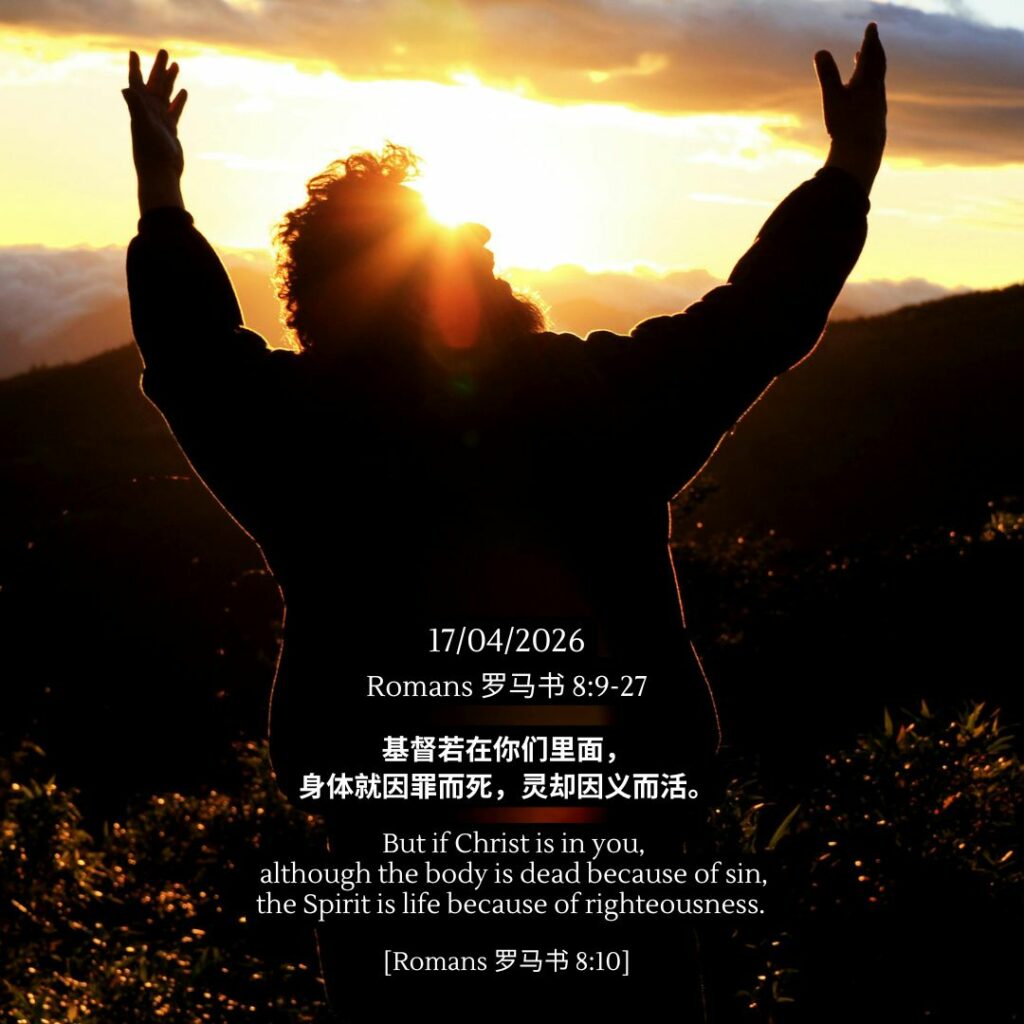
Romans 8:9-27
But if Christ is in you, although the body is dead because of sin, the Spirit is life because of righteousness. – Romans 8:10
Click to read passage
Identity is foundational to a person’s sense of self and place in the world. It answers questions like “Who am I?”, “Where do I belong?”, and “What is my worth?” Think about the generation in the wilderness. For forty years, they wandered in a barren land. Who were they? Why were they there? Although manna was provided daily, where was the God who supplied it? When would it all end?
In this week’s passage from Numbers, the answer begins to emerge. “After the plague…” the word of the Lord came to Moses and Eleazar the priest: “Take a census of the whole Israelite community… all those twenty years old or more who are able to go to war” (Numbers 26:1–2). This act of counting symbolised God’s renewed calling of His people, bringing hope to those wandering in the wilderness. It reminded them that the God who watches over them is real and that they belong to Him.
After the census, God again instructed His people to present offerings regularly (daily, weekly, monthly, and yearly), with reverence, gratitude, and sincerity. In the Old Testament, sacrifices were a means of relating to God. Through them, God established a covenant relationship with His people. The people, in turn, were reminded that they were set apart for the Lord. And God, as He had promised, dwelt among them as their God.
Yet no matter how detailed the sacrificial system was, the people could not truly become acceptable to God through rituals alone. As the prophet Hosea declared, “I desire mercy, not sacrifice, and acknowledgement of God rather than burnt offerings” (Hosea 6:6). God had already grown weary of empty rituals where sin and worship coexisted. David also said, “The sacrifices of God are a broken spirit” (Psalm 51:17). This was something the people could not offer on their own, and where they continually fell short of God’s heart.
Today, these Old Testament accounts may seem distant, yet the condition of the Israelites often reflects our own lives. Many of us still walk through our own “wilderness.” The world around us is unstable, and the pressures of life, in family, work, and relationships, can easily fill us with anxiety.
But today, God’s Word speaks to us. The apostle Paul says, if the Spirit of God lives in you, you are not in the flesh but in the Spirit (Romans 8:9). The Holy Spirit dwelling in us is our assurance and our witness, reminding us that we are God’s children. Because of the Spirit we have received, we can call God, who rules over all and provides for us, “Abba, Father” (vv.15–16).
What a glorious identity this is. It is no longer maintained through sacrifices, but accomplished once and for all through Jesus Christ. All who believe in Him and receive Him as Lord and Saviour are made children of God, “heirs with Christ” (v.17).
In our daily lives, circumstances may not immediately change. You may still feel as though you are in a wilderness, facing weaknesses and struggles. Yet there is no need to fear. The Spirit who dwells in us helps us live a victorious life. This is our greatest hope, and it is a living reality. The Holy Spirit continues to renew us, strengthen our faith, and enable us to walk faithfully as we await the glory to come.
Reflection:
Am I sensitive to the leading of the Holy Spirit today? What challenges am I currently facing? How does this passage help me view my situation from an eternal perspective?
Prayer:
Dear Lord Jesus, thank You for Your redemption and for giving us the Holy Spirit to dwell within us, constantly reminding us that we are Your children. Holy Spirit, take full control of my life. No matter how my circumstances change, help me to look to You and wait upon You with an eternal perspective. In Jesus’ victorious name we pray, Amen.
Click to read passage
Identity is foundational to a person’s sense of self and place in the world. It answers questions like “Who am I?”, “Where do I belong?”, and “What is my worth?” Think about the generation in the wilderness. For forty years, they wandered in a barren land. Who were they? Why were they there? Although manna was provided daily, where was the God who supplied it? When would it all end?
In this week’s passage from Numbers, the answer begins to emerge. “After the plague…” the word of the Lord came to Moses and Eleazar the priest: “Take a census of the whole Israelite community… all those twenty years old or more who are able to go to war” (Numbers 26:1–2). This act of counting symbolised God’s renewed calling of His people, bringing hope to those wandering in the wilderness. It reminded them that the God who watches over them is real and that they belong to Him.
After the census, God again instructed His people to present offerings regularly (daily, weekly, monthly, and yearly), with reverence, gratitude, and sincerity. In the Old Testament, sacrifices were a means of relating to God. Through them, God established a covenant relationship with His people. The people, in turn, were reminded that they were set apart for the Lord. And God, as He had promised, dwelt among them as their God.
Yet no matter how detailed the sacrificial system was, the people could not truly become acceptable to God through rituals alone. As the prophet Hosea declared, “I desire mercy, not sacrifice, and acknowledgement of God rather than burnt offerings” (Hosea 6:6). God had already grown weary of empty rituals where sin and worship coexisted. David also said, “The sacrifices of God are a broken spirit” (Psalm 51:17). This was something the people could not offer on their own, and where they continually fell short of God’s heart.
Today, these Old Testament accounts may seem distant, yet the condition of the Israelites often reflects our own lives. Many of us still walk through our own “wilderness.” The world around us is unstable, and the pressures of life, in family, work, and relationships, can easily fill us with anxiety.
But today, God’s Word speaks to us. The apostle Paul says, if the Spirit of God lives in you, you are not in the flesh but in the Spirit (Romans 8:9). The Holy Spirit dwelling in us is our assurance and our witness, reminding us that we are God’s children. Because of the Spirit we have received, we can call God, who rules over all and provides for us, “Abba, Father” (vv.15–16).
What a glorious identity this is. It is no longer maintained through sacrifices, but accomplished once and for all through Jesus Christ. All who believe in Him and receive Him as Lord and Saviour are made children of God, “heirs with Christ” (v.17).
In our daily lives, circumstances may not immediately change. You may still feel as though you are in a wilderness, facing weaknesses and struggles. Yet there is no need to fear. The Spirit who dwells in us helps us live a victorious life. This is our greatest hope, and it is a living reality. The Holy Spirit continues to renew us, strengthen our faith, and enable us to walk faithfully as we await the glory to come.
Reflection:
Am I sensitive to the leading of the Holy Spirit today? What challenges am I currently facing? How does this passage help me view my situation from an eternal perspective?
Prayer:
Dear Lord Jesus, thank You for Your redemption and for giving us the Holy Spirit to dwell within us, constantly reminding us that we are Your children. Holy Spirit, take full control of my life. No matter how my circumstances change, help me to look to You and wait upon You with an eternal perspective. In Jesus’ victorious name we pray, Amen.