
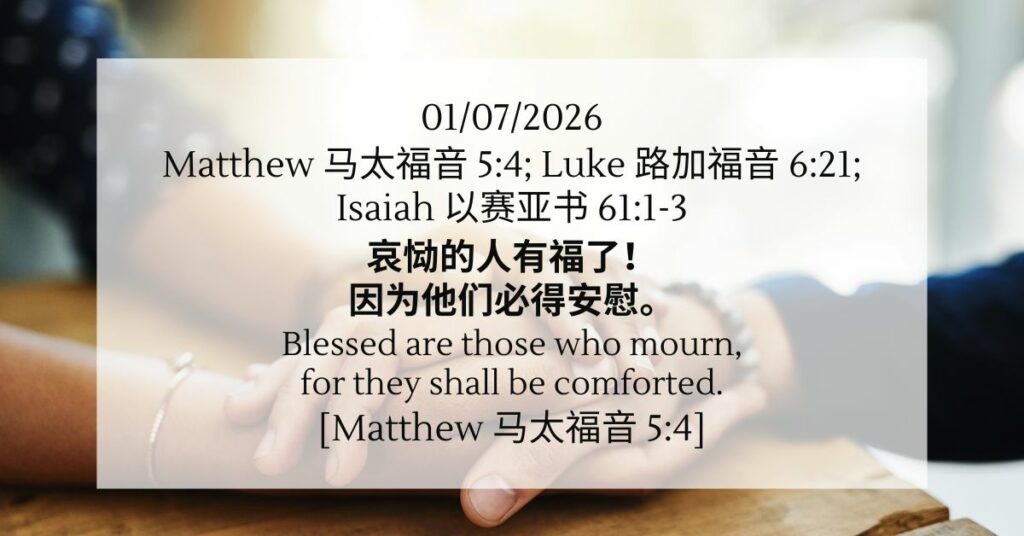
Matthew 5:4, Luke 6:21, Isaiah 61:1-3
Blessed are those who mourn, for they shall be comforted. – Matthew 5:4
Click to read passage
If you ever take a quiet drive up to the hillside of Kranji, you will find yourself standing in one of the most sacred spaces in Singapore: the Kranji War Cemetery.
Walk past the rows of uniform white headstones to the highest terrace, and you’ll find the Singapore Memorial — twelve stone columns inscribed with the names of over twenty-four thousand Commonwealth soldiers, airmen, and sailors lost in World War II with no known graves. For years after the war, relatives don’t bring banners or celebrations; they bring tears. They stand before those columns, weep quietly, and trace a carved name with their fingers. Nearby, on a great limestone slab, five words are carved: “”THEIR NAME LIVETH FOR EVERMORE”” – A promise, made on behalf of all humanity, to every broken heart that arrives on that hill: your sorrow is not forgotten.
That sanctuary in Kranji gives us a fast, clear glimpse into the heartbeat of the second Beatitude.
In Singapore, we are uncomfortable with grief and are conditioned to mask our pain, to “”get over it,”” and to project a facade of toxic positivity. Our world says: blessed are the happy, blessed are the unbothered, and blessed are those who can distract themselves with pleasure.
But King Jesus walks right into the hillsides of our private grief, looks at our inner cries, and says: “”Blessed are those who mourn, for they will be comforted.”” Jesus wants us to embrace our brokenness, grief and loss.
In our modern era of mental health awareness, we must be careful not to swing to the opposite extreme and use this scripture as a legitimate excuse to settle into perpetual negative moods. A negative mood is often self-absorbed and loops in a cycle of cynicism or complaint that echo inward, but biblical mourning is taking the honesty of our brokenness, pain, anger and actively pouring it out before God. Jesus isn’t glorifying a bad mood or calling us to wallow in a negative emotional state. He is calling us to drop the facade of having it all together, because you cannot be healed of a wound you refuse to admit.
Jesus is declaring that in His Kingdom, our pain is not an operational failure or a disqualification. God does not distance Himself from our heavy heart; He is drawn to it. Your tears are not an inconvenience to Him, but a homing beacon for His presence.
The promise of Jesus is not that we will never weep. The promise is that when we do, we do not weep alone. Just like those permanent inscriptions carved into the stone at Kranji, God has written an enduring promise over your life. He sees the silent burnout, the family anxieties, and the quiet disappointments you are carrying into this Wednesday. Bring your raw, unedited sorrow to Him today, because the Comforter is already standing right before you.
Reflection:
First, look at the emotional weight you are carrying, what is the hidden grief or disappointment that you have been trying to suppress, and what would it look like to acknowledge it honestly before Jesus right now?
Second, reflecting on your emotions lately—have you been merely venting your negative moods to yourself, or have you been practicing the active, relational step of bringing your brokenness to God for His comfort to change you?
Let us pray:
Jesus, thank You that You are a Savior who is well-acquainted with grief and close to the brokenhearted. Forgive us for trying to hide our wounds behind a mask of false strength, and forgive us when we wallow in negative moods without bringing them to You. We bring our raw, heavy hearts to You today—our lost dreams, our relational anxieties, and our overwhelming pressures. Wrap us in Your unexplainable peace, and remind us that our tears are safe in Your hands. May we experience the reality today that Your comfort is not the absence of our sorrow, but the beautiful, tangible presence of Your. In Jesus’ name, Amen.
Click to read passage
If you ever take a quiet drive up to the hillside of Kranji, you will find yourself standing in one of the most sacred spaces in Singapore: the Kranji War Cemetery.
Walk past the rows of uniform white headstones to the highest terrace, and you’ll find the Singapore Memorial — twelve stone columns inscribed with the names of over twenty-four thousand Commonwealth soldiers, airmen, and sailors lost in World War II with no known graves. For years after the war, relatives don’t bring banners or celebrations; they bring tears. They stand before those columns, weep quietly, and trace a carved name with their fingers. Nearby, on a great limestone slab, five words are carved: “”THEIR NAME LIVETH FOR EVERMORE”” – A promise, made on behalf of all humanity, to every broken heart that arrives on that hill: your sorrow is not forgotten.
That sanctuary in Kranji gives us a fast, clear glimpse into the heartbeat of the second Beatitude.
In Singapore, we are uncomfortable with grief and are conditioned to mask our pain, to “”get over it,”” and to project a facade of toxic positivity. Our world says: blessed are the happy, blessed are the unbothered, and blessed are those who can distract themselves with pleasure.
But King Jesus walks right into the hillsides of our private grief, looks at our inner cries, and says: “”Blessed are those who mourn, for they will be comforted.”” Jesus wants us to embrace our brokenness, grief and loss.
In our modern era of mental health awareness, we must be careful not to swing to the opposite extreme and use this scripture as a legitimate excuse to settle into perpetual negative moods. A negative mood is often self-absorbed and loops in a cycle of cynicism or complaint that echo inward, but biblical mourning is taking the honesty of our brokenness, pain, anger and actively pouring it out before God. Jesus isn’t glorifying a bad mood or calling us to wallow in a negative emotional state. He is calling us to drop the facade of having it all together, because you cannot be healed of a wound you refuse to admit.
Jesus is declaring that in His Kingdom, our pain is not an operational failure or a disqualification. God does not distance Himself from our heavy heart; He is drawn to it. Your tears are not an inconvenience to Him, but a homing beacon for His presence.
The promise of Jesus is not that we will never weep. The promise is that when we do, we do not weep alone. Just like those permanent inscriptions carved into the stone at Kranji, God has written an enduring promise over your life. He sees the silent burnout, the family anxieties, and the quiet disappointments you are carrying into this Wednesday. Bring your raw, unedited sorrow to Him today, because the Comforter is already standing right before you.
Reflection:
First, look at the emotional weight you are carrying, what is the hidden grief or disappointment that you have been trying to suppress, and what would it look like to acknowledge it honestly before Jesus right now?
Second, reflecting on your emotions lately—have you been merely venting your negative moods to yourself, or have you been practicing the active, relational step of bringing your brokenness to God for His comfort to change you?
Let us pray:
Jesus, thank You that You are a Savior who is well-acquainted with grief and close to the brokenhearted. Forgive us for trying to hide our wounds behind a mask of false strength, and forgive us when we wallow in negative moods without bringing them to You. We bring our raw, heavy hearts to You today—our lost dreams, our relational anxieties, and our overwhelming pressures. Wrap us in Your unexplainable peace, and remind us that our tears are safe in Your hands. May we experience the reality today that Your comfort is not the absence of our sorrow, but the beautiful, tangible presence of Your. In Jesus’ name, Amen.