
Matthew 6:19-24
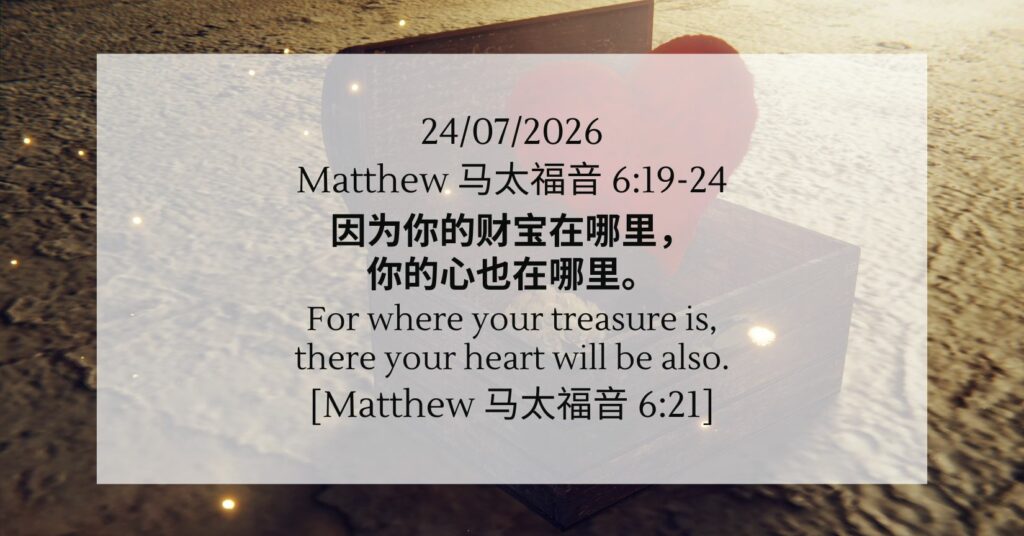
For where your treasure is,there your heart will be also. – Matthew 6:12
Click to read passage
Earthly treasure isn’t inherently wrong. Jesus simply tells us that it is temporary. The things we can touch and count will eventually be subject to moths, rust, or thieves. Heavenly treasure, in contrast, is secure because it belongs to a kingdom we enter by grace, not by merit. To “lay up treasure in heaven” is not so much an instruction to perform, but an invitation to live by the priorities of the heavenly kingdom to which we already belong.
That is why verse 21 matters so much. Jesus does not say, “put your treasure where your heart already is.” He says the reverse: where your treasure is, there your heart will follow. What we choose to value both reveals and shapes the direction of our hearts. We rarely wake up one morning having decided to love money more than God. It happens quietly, one small investment of attention and hope at a time, until we notice our heart has moved without our permission.
The image of the eye as a lamp continues this thought from another angle. A “bad eye” in Jesus’ culture was a well-known idiom for stinginess or greediness. A grasping and ungenerous way of seeing the world and the people in it. A “healthy eye,” then, is not only clear sight but a generous one. How we use what we have says something about the light or darkness inside us. Generosity is not just a nice virtue added on top of faith. It is evidence of whether our inner life is oriented toward the kingdom or turned inward on itself.
All of this comes to a point in verse 24. Jesus is not exaggerating when he says no one can serve two masters. In the ancient world, a slave belonged wholly to one owner, without divided loyalty. God does not ask to be one priority among several. He asks for the same total, undivided ownership. Money is not evil in itself, but it has the potential to turn into a rival master, quietly demanding the trust, security, and devotion that belong to God alone.
Perhaps that is the honest question underneath this whole passage. Not “how much do I have,” but “who owns me.” Our bank balances, our comfort, our plans for the future, none of these are wrong to hold. But they were never meant to hold us.
Reflection:
What have I been storing up lately, and where is my heart following it?
In what areas of my life would a more generous “eye” change how I see and treat others?
Is there a part of my life where money, security, or comfort has quietly become my master?
Prayer:
Heavenly Father God, search our hearts and show us where our treasure truly lies. Free us from the exhausting work of trying to earn what only your grace can give, and grow in us instead a generous eye and an undivided love for you. Where money or possessions have taken hold of us, help us to instead turn our hearts back to you. Let our hearts follow you, because that is where we have chosen to lay up our treasure. In Jesus’ name we pray. Amen.
Click to read passage
Earthly treasure isn’t inherently wrong. Jesus simply tells us that it is temporary. The things we can touch and count will eventually be subject to moths, rust, or thieves. Heavenly treasure, in contrast, is secure because it belongs to a kingdom we enter by grace, not by merit. To “lay up treasure in heaven” is not so much an instruction to perform, but an invitation to live by the priorities of the heavenly kingdom to which we already belong.
That is why verse 21 matters so much. Jesus does not say, “put your treasure where your heart already is.” He says the reverse: where your treasure is, there your heart will follow. What we choose to value both reveals and shapes the direction of our hearts. We rarely wake up one morning having decided to love money more than God. It happens quietly, one small investment of attention and hope at a time, until we notice our heart has moved without our permission.
The image of the eye as a lamp continues this thought from another angle. A “bad eye” in Jesus’ culture was a well-known idiom for stinginess or greediness. A grasping and ungenerous way of seeing the world and the people in it. A “healthy eye,” then, is not only clear sight but a generous one. How we use what we have says something about the light or darkness inside us. Generosity is not just a nice virtue added on top of faith. It is evidence of whether our inner life is oriented toward the kingdom or turned inward on itself.
All of this comes to a point in verse 24. Jesus is not exaggerating when he says no one can serve two masters. In the ancient world, a slave belonged wholly to one owner, without divided loyalty. God does not ask to be one priority among several. He asks for the same total, undivided ownership. Money is not evil in itself, but it has the potential to turn into a rival master, quietly demanding the trust, security, and devotion that belong to God alone.
Perhaps that is the honest question underneath this whole passage. Not “how much do I have,” but “who owns me.” Our bank balances, our comfort, our plans for the future, none of these are wrong to hold. But they were never meant to hold us.
Reflection:
What have I been storing up lately, and where is my heart following it?
In what areas of my life would a more generous “eye” change how I see and treat others?
Is there a part of my life where money, security, or comfort has quietly become my master?
Prayer:
Heavenly Father God, search our hearts and show us where our treasure truly lies. Free us from the exhausting work of trying to earn what only your grace can give, and grow in us instead a generous eye and an undivided love for you. Where money or possessions have taken hold of us, help us to instead turn our hearts back to you. Let our hearts follow you, because that is where we have chosen to lay up our treasure. In Jesus’ name we pray. Amen.