
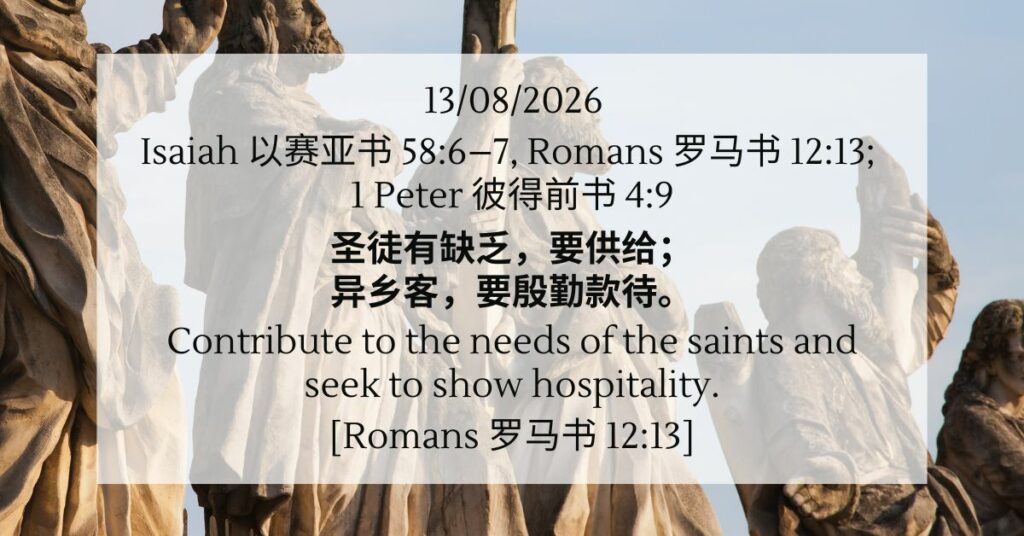
Isaiah 58:6–7, Romans 12:13; 1 Peter 4:9
Contribute to the needs of the saints andseek to show hospitality. – Romans 12:13
Click to read passage
Jesus prophesied that in the last days the love of many would grow cold. He said, “And because lawlessness will be increased, the love of many will grow cold.” (Matthew 24:12)
When love grows cold, we slowly lose concern for the people and things around us. We become unwilling to give our time and energy to help others. We may even grow numb to the pain and needs of those around us. Our relationships turn cold, selfish and self-centred. We drift from family, friends and community, and quietly avoid fellowship with others. This morning’s three short passages act like a mirror, helping us examine whether our own love has quietly grown cold.
Those who only look at the surface, without asking what truly matters, can take great pride in fasting. But the word of the Lord God comes like a sudden blow. “Is not this the fast that I choose: to loose the bonds of wickedness, to undo the straps of the yoke, to let the oppressed go free, and to break every yoke? Is it not to share your bread with the hungry and bring the homeless poor into your house, and when you see the naked, to cover him, and not to hide yourself from your own flesh?” (Isaiah 58:6-7)
The people of Israel at that time were caught in hypocrisy and empty religious form. On the surface, they kept strict fasts and humbled themselves, appearing very devout. But their faith had lost all connection to daily life. It was faith for show. What God asks of His people is a heart aligned with His, from the inside out. He is a God of compassion, and His people should never grow numb to the pain and needs of others, much less place cruel burdens upon them.
The apostle Paul wrote, “Contribute to the needs of the saints and seek to show hospitality.” (Romans 12:13) Here, “guests” refers to fellow believers in Christ (1 Timothy 3:2; 5:10). Paul urges Christians to put love into practical action, turning inward faith into concrete and sincere care by providing for needy believers and warmly welcoming strangers.
It is worth noting that Scripture does not call us to welcome every guest without discernment. The apostle John tells us not to receive false teachers into our homes, nor even to greet them. (2 John 10) This is not a lack of love. It is a way of guarding the truth and protecting the church and our families from being led astray. John, known as the apostle of love, still insists that love must rest on truth. To welcome or warmly greet a false teacher is, in effect, to lend support to their error.
The apostle Peter wrote, “Show hospitality to one another without grumbling.” (1 Peter 4:9) Just before this, he reminds believers that the end of all things is near, and urges them above all to love one another earnestly. (1 Peter 4:7-8) Showing hospitality without grumbling is love in its most concrete form. In that time, travel was difficult, and masters and servants went out to preach the gospel. Believers who faced persecution often had to flee and scatter to other places, so receiving and caring for others became a vital act of service. This kind of hospitality may have looked like a simple matter of food and shelter, but it was truly a test of love. And when love is tested, grumbling comes easily. So Peter urges us here, show hospitality to one another without grumbling.
Last Wednesday, fifty-six-year-old Irish singer Glen Hansard died in a car accident. Friends said the tributes that filled social media in his memory brought unusual warmth to a space usually full of anger and complaint. People simply shared small stories about him. Someone recalled seeing him sing again and again alongside street performers. A homeless man remembered how Hansard once brought him back to a shelter and sang for everyone there. Hansard never forgot where he came from. For fifteen years running, every Christmas Eve, he performed on a street in Dublin to raise funds for a charity supporting the homeless.
A friend said in his eulogy, “Hansard was like a mischievous angel, real and present.” To the many lives he touched, he truly felt like an angel, present and real. At his funeral, a passage from the Gospel of John was read, reminding everyone that he had been welcomed home by the Lord to the place prepared for him. What remains of his life are these small stories that continue to warm hearts and inspire us to bring more goodness into the world.
Reflection:
Has my love grown cold, little by little? Do I respond to the pain and needs of others, or have I grown numb to them? Can my life leave behind small stories that warm hearts, the way Hansard’s did? Am I learning to show hospitality to others? Are my mouth and my heart filled with complaints?
Prayer:
Dear Abba Father, forgive the self-centeredness in our lives. You are a God full of compassion and grace, and Your love for the world is a sacrificial love. Shape us to live out Your nature too. Help us not to grow numb to the pain and needs of others. Teach us to show hospitality to one another without complaint. Let Your love flow through us to everyone we meet. We ask this in the victorious name of our Lord Jesus Christ. Amen!
Click to read passage
Jesus prophesied that in the last days the love of many would grow cold. He said, “And because lawlessness will be increased, the love of many will grow cold.” (Matthew 24:12)
When love grows cold, we slowly lose concern for the people and things around us. We become unwilling to give our time and energy to help others. We may even grow numb to the pain and needs of those around us. Our relationships turn cold, selfish and self-centred. We drift from family, friends and community, and quietly avoid fellowship with others. This morning’s three short passages act like a mirror, helping us examine whether our own love has quietly grown cold.
Those who only look at the surface, without asking what truly matters, can take great pride in fasting. But the word of the Lord God comes like a sudden blow. “Is not this the fast that I choose: to loose the bonds of wickedness, to undo the straps of the yoke, to let the oppressed go free, and to break every yoke? Is it not to share your bread with the hungry and bring the homeless poor into your house, and when you see the naked, to cover him, and not to hide yourself from your own flesh?” (Isaiah 58:6-7)
The people of Israel at that time were caught in hypocrisy and empty religious form. On the surface, they kept strict fasts and humbled themselves, appearing very devout. But their faith had lost all connection to daily life. It was faith for show. What God asks of His people is a heart aligned with His, from the inside out. He is a God of compassion, and His people should never grow numb to the pain and needs of others, much less place cruel burdens upon them.
The apostle Paul wrote, “Contribute to the needs of the saints and seek to show hospitality.” (Romans 12:13) Here, “guests” refers to fellow believers in Christ (1 Timothy 3:2; 5:10). Paul urges Christians to put love into practical action, turning inward faith into concrete and sincere care by providing for needy believers and warmly welcoming strangers.
It is worth noting that Scripture does not call us to welcome every guest without discernment. The apostle John tells us not to receive false teachers into our homes, nor even to greet them. (2 John 10) This is not a lack of love. It is a way of guarding the truth and protecting the church and our families from being led astray. John, known as the apostle of love, still insists that love must rest on truth. To welcome or warmly greet a false teacher is, in effect, to lend support to their error.
The apostle Peter wrote, “Show hospitality to one another without grumbling.” (1 Peter 4:9) Just before this, he reminds believers that the end of all things is near, and urges them above all to love one another earnestly. (1 Peter 4:7-8) Showing hospitality without grumbling is love in its most concrete form. In that time, travel was difficult, and masters and servants went out to preach the gospel. Believers who faced persecution often had to flee and scatter to other places, so receiving and caring for others became a vital act of service. This kind of hospitality may have looked like a simple matter of food and shelter, but it was truly a test of love. And when love is tested, grumbling comes easily. So Peter urges us here, show hospitality to one another without grumbling.
Last Wednesday, fifty-six-year-old Irish singer Glen Hansard died in a car accident. Friends said the tributes that filled social media in his memory brought unusual warmth to a space usually full of anger and complaint. People simply shared small stories about him. Someone recalled seeing him sing again and again alongside street performers. A homeless man remembered how Hansard once brought him back to a shelter and sang for everyone there. Hansard never forgot where he came from. For fifteen years running, every Christmas Eve, he performed on a street in Dublin to raise funds for a charity supporting the homeless.
A friend said in his eulogy, “Hansard was like a mischievous angel, real and present.” To the many lives he touched, he truly felt like an angel, present and real. At his funeral, a passage from the Gospel of John was read, reminding everyone that he had been welcomed home by the Lord to the place prepared for him. What remains of his life are these small stories that continue to warm hearts and inspire us to bring more goodness into the world.
Reflection:
Has my love grown cold, little by little? Do I respond to the pain and needs of others, or have I grown numb to them? Can my life leave behind small stories that warm hearts, the way Hansard’s did? Am I learning to show hospitality to others? Are my mouth and my heart filled with complaints?
Prayer:
Dear Abba Father, forgive the self-centeredness in our lives. You are a God full of compassion and grace, and Your love for the world is a sacrificial love. Shape us to live out Your nature too. Help us not to grow numb to the pain and needs of others. Teach us to show hospitality to one another without complaint. Let Your love flow through us to everyone we meet. We ask this in the victorious name of our Lord Jesus Christ. Amen!