
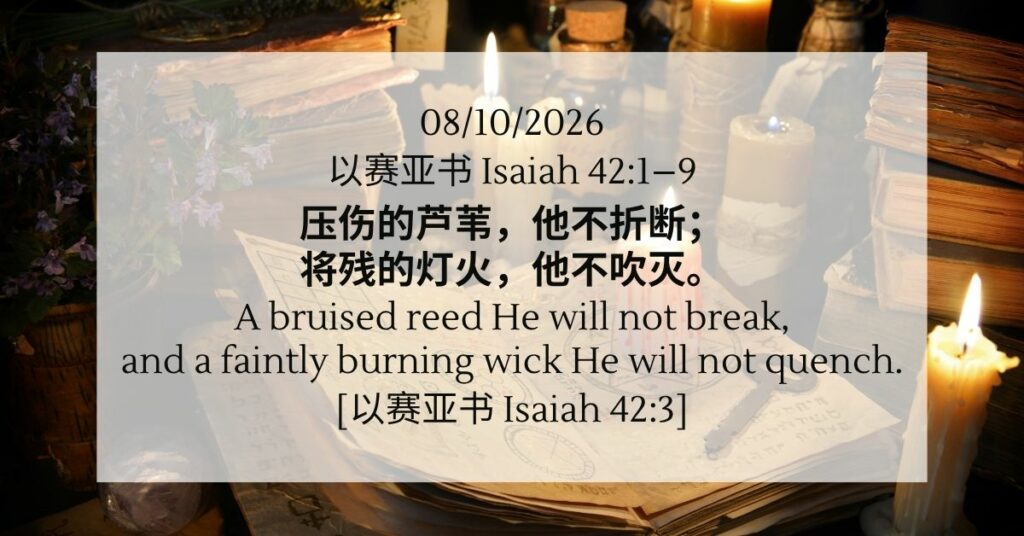
Isaiah 42:1–9
A bruised reed He will not break,
and a faintly burning wick He will not quench. – Isaiah 42:3
Click to read passage
Isaiah chapters 40–55 are commonly referred to as the “Book of Consolation.” In the face of prophecies of judgment regarding the coming Babylonian exile and the suffering experienced during that time, God proclaimed a message of deliverance and hope to His people through the prophet.
I wonder what insights and resonances you, brothers and sisters, have gained while reading and studying the Book of Isaiah in the Old Testament? What do we feel when we read about the exile of the people of Israel? With the people of Israel in the midst of great tribulation, how precious was the message God delivered through the prophet—and how do we receive it today?
The fundamental cause of the Israelites’ captivity was their abandonment of the LORD’s commandments, their worship of idols, and their political betrayal, which ultimately led to God’s discipline and invasion by foreign empires. They were taken into captivity multiple times, culminating in the destruction of Jerusalem and the Temple of Solomon.
For the people of Israel, this was a catastrophic experience—one that brought utter destruction and upended their national, religious, and ethnic identities. In their understanding, Jerusalem was God’s chosen dwelling place, and Solomon’s Temple was a symbol of God’s glorious presence; they had firmly believed that God would surely protect His holy city and temple from being shaken! —Israel, as a spiritually blind servant, experienced failure and God’s discipline!
However, God’s ideal Servant appeared! His coming was God’s answer! The prophet Isaiah said, “Behold my servant, whom I uphold, my chosen, in whom my soul delights; I have put my Spirit upon him; he will bring forth justice to the nations.” (v. 1) He is not only chosen by God to fulfil the mission entrusted to Him, but He co-labours with God and also has God’s presence. He has been appointed by God, and He will carry out a universal mission—proclaiming God’s truth to all nations.
God’s ideal servant will accomplish a great work, but not with fanfare or commotion; rather, He will work quietly, modestly, gently, and humbly: “He will not cry aloud or lift up his voice,
or make it heard in the street.” (verse 2). He does not need the support of the powerful or the endorsement of the masses; He does not rely on force or a loud voice to coerce others, nor does He boast about Himself. “A bruised reed he will not break, and a faintly burning wick he will not quench.” (verse 3a) He does not look down on people; even when they are utterly useless and beyond repair, this Servant embodies gentleness, compassion, and enduring patience.
“To open the eyes that are blind, to bring out the prisoners from the dungeon, from the prison those who sit in darkness” (verse 7) This Servant of God brings light to people and sets the captive free; He fulfils God’s will! —God’s righteousness and His mercy toward the weak and wounded are both revealed in this Servant!
Reflection:
How do the righteousness, gentleness, and mercy displayed by this Servant challenge my attitude and approach toward others? Where can I bring forth God’s light, righteousness, and mercy this week?
Prayer:
Glorious Heavenly Father, thank You for preparing this perfect Servant for us—the Lord Jesus! The world may be deceived by carved idols, but the Lord Jesus will “open the eyes that are blind, to bring out the prisoners from the dungeon, from the prison those who sit in darkness.” He will bring light to the blind and freedom to the captive; He will fulfil Your will for the world! Thank You for sending Your Son, Jesus, to save us. Please help me to follow the example of the Lord Jesus and treat others with righteousness, gentleness, and mercy in my daily life. I pray in the name of the Lord Jesus Christ. Amen.
Click to read passage
Isaiah chapters 40–55 are commonly referred to as the “Book of Consolation.” In the face of prophecies of judgment regarding the coming Babylonian exile and the suffering experienced during that time, God proclaimed a message of deliverance and hope to His people through the prophet.
I wonder what insights and resonances you, brothers and sisters, have gained while reading and studying the Book of Isaiah in the Old Testament? What do we feel when we read about the exile of the people of Israel? With the people of Israel in the midst of great tribulation, how precious was the message God delivered through the prophet—and how do we receive it today?
The fundamental cause of the Israelites’ captivity was their abandonment of the LORD’s commandments, their worship of idols, and their political betrayal, which ultimately led to God’s discipline and invasion by foreign empires. They were taken into captivity multiple times, culminating in the destruction of Jerusalem and the Temple of Solomon.
For the people of Israel, this was a catastrophic experience—one that brought utter destruction and upended their national, religious, and ethnic identities. In their understanding, Jerusalem was God’s chosen dwelling place, and Solomon’s Temple was a symbol of God’s glorious presence; they had firmly believed that God would surely protect His holy city and temple from being shaken! —Israel, as a spiritually blind servant, experienced failure and God’s discipline!
However, God’s ideal Servant appeared! His coming was God’s answer! The prophet Isaiah said, “Behold my servant, whom I uphold, my chosen, in whom my soul delights; I have put my Spirit upon him; he will bring forth justice to the nations.” (v. 1) He is not only chosen by God to fulfil the mission entrusted to Him, but He co-labours with God and also has God’s presence. He has been appointed by God, and He will carry out a universal mission—proclaiming God’s truth to all nations.
God’s ideal servant will accomplish a great work, but not with fanfare or commotion; rather, He will work quietly, modestly, gently, and humbly: “He will not cry aloud or lift up his voice,
or make it heard in the street.” (verse 2). He does not need the support of the powerful or the endorsement of the masses; He does not rely on force or a loud voice to coerce others, nor does He boast about Himself. “A bruised reed he will not break, and a faintly burning wick he will not quench.” (verse 3a) He does not look down on people; even when they are utterly useless and beyond repair, this Servant embodies gentleness, compassion, and enduring patience.
“To open the eyes that are blind, to bring out the prisoners from the dungeon, from the prison those who sit in darkness” (verse 7) This Servant of God brings light to people and sets the captive free; He fulfils God’s will! —God’s righteousness and His mercy toward the weak and wounded are both revealed in this Servant!
Reflection:
How do the righteousness, gentleness, and mercy displayed by this Servant challenge my attitude and approach toward others? Where can I bring forth God’s light, righteousness, and mercy this week?
Prayer:
Glorious Heavenly Father, thank You for preparing this perfect Servant for us—the Lord Jesus! The world may be deceived by carved idols, but the Lord Jesus will “open the eyes that are blind, to bring out the prisoners from the dungeon, from the prison those who sit in darkness.” He will bring light to the blind and freedom to the captive; He will fulfil Your will for the world! Thank You for sending Your Son, Jesus, to save us. Please help me to follow the example of the Lord Jesus and treat others with righteousness, gentleness, and mercy in my daily life. I pray in the name of the Lord Jesus Christ. Amen.