
James 5:7–10
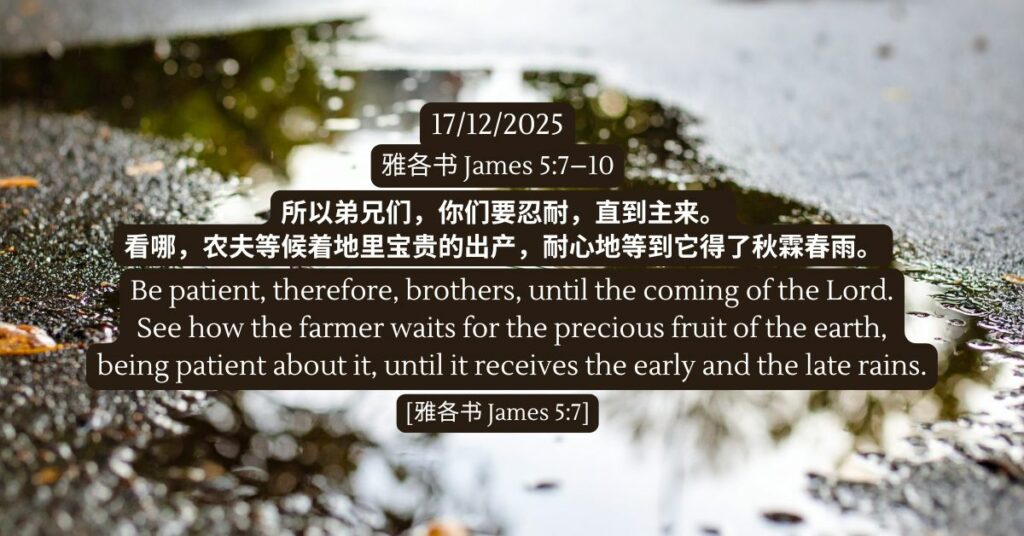
Be patient, therefore, brothers, until the coming of the Lord. See how the farmer waits for the precious fruit of the earth, being patient about it, until it receives the early and the late rains. – James 5:7
Click to read the passage
Advent is a season that holds together two horizons: Christ has come, and Christ is coming again. We look back to the manger, yet also look forward to the day when the Judge stands at the door. In this in-between time, between His first coming and His return, James calls the church to a posture of waiting with endurance shaped by the coming of the Lord.
Before offering comfort, James had earlier condemned the rich oppressors who misuse their power (4:13–5:6). They boast in controlling their future and exploit the poor, but James declares their judgment certain and imminent. Their present luxury cannot prevent the coming reckoning.
After this tirade, James turns tenderly to his true audience: “Be patient, therefore, brothers, until the coming of the Lord. ” (v. 7). The use of “brothers” signals a pastoral shift, from warning the arrogant to comforting the afflicted. These believers have suffered injustice, and to them James gives not escape but vision: the Lord is already on His way.
To picture this waiting, James points to the fields: “See how the farmer waits for the precious fruit of the earth, being patient about it, until it receives the early and the late rains.” (v. 7b). In ancient Palestine, the “early rains” fell soon after sowing season—softening the ground, enabling growth to begin. The “late rains” came just before harvest—bringing fruit to maturity. Between these two rains lay long months of uncertainty, vulnerability, and dependence. The farmer cannot rush the process. He cannot manipulate the skies. He can only trust the God who governs seasons.
James says: This is Christian waiting. We live between the “early rain” of Christ’s first coming and the “late rain” of His return. The kingdom has been planted, but the full harvest is still ahead. So we wait—not passively, but with steady trust that God will finish what He began.
Thus James urges: “You also, be patient. Establish your hearts, for the coming of the Lord is at hand.” (v. 8). This is more than endurance; it is a call to firm up our inner resolve—to anchor ourselves to God’s ways and God’s timing. Christ is not far off; He is at the door. His arrival is already unfolding. So James warns against grumbling (v. 9). Nothing damages community more quickly than frustration spilling into blame. Awareness of God’s nearness should lead to peace with God and with one another.
Finally, he points to the prophets (v. 10)—those who suffered yet remained steadfast because they trusted God’s purposes. They lived faithfully in the present because they saw the future God had promised. Advent invites us into this same story. The God who came in humility will return in glory. The early rain has fallen; the late rain is on its way. So we wait—trusting that the Judge at the door is also the Saviour who loves us.
Reflection:
1. Where in your life is God inviting you to practice “farmer-like” patience—trusting Him for what you cannot control?
2. How does remembering that “the Judge is standing at the door” help you live with greater peace, integrity, and harmony in your relationships?
Prayer:
Dear Lord Jesus, we thank You that You have come and that You will come again. As we live between these two truths, teach us to wait like the farmer—with patience, trust, and hope in you. Give us peace that allays all anxiety. Strengthen our hands and hearts where we are weary. Keep us steadfast in doing good. We pray this, in Jesus’ name, Amen.
Click to read the passage
Advent is a season that holds together two horizons: Christ has come, and Christ is coming again. We look back to the manger, yet also look forward to the day when the Judge stands at the door. In this in-between time, between His first coming and His return, James calls the church to a posture of waiting with endurance shaped by the coming of the Lord.
Before offering comfort, James had earlier condemned the rich oppressors who misuse their power (4:13–5:6). They boast in controlling their future and exploit the poor, but James declares their judgment certain and imminent. Their present luxury cannot prevent the coming reckoning.
After this tirade, James turns tenderly to his true audience: “Be patient, therefore, brothers, until the coming of the Lord. ” (v. 7). The use of “brothers” signals a pastoral shift, from warning the arrogant to comforting the afflicted. These believers have suffered injustice, and to them James gives not escape but vision: the Lord is already on His way.
To picture this waiting, James points to the fields: “See how the farmer waits for the precious fruit of the earth, being patient about it, until it receives the early and the late rains.” (v. 7b). In ancient Palestine, the “early rains” fell soon after sowing season—softening the ground, enabling growth to begin. The “late rains” came just before harvest—bringing fruit to maturity. Between these two rains lay long months of uncertainty, vulnerability, and dependence. The farmer cannot rush the process. He cannot manipulate the skies. He can only trust the God who governs seasons.
James says: This is Christian waiting. We live between the “early rain” of Christ’s first coming and the “late rain” of His return. The kingdom has been planted, but the full harvest is still ahead. So we wait—not passively, but with steady trust that God will finish what He began.
Thus James urges: “You also, be patient. Establish your hearts, for the coming of the Lord is at hand.” (v. 8). This is more than endurance; it is a call to firm up our inner resolve—to anchor ourselves to God’s ways and God’s timing. Christ is not far off; He is at the door. His arrival is already unfolding. So James warns against grumbling (v. 9). Nothing damages community more quickly than frustration spilling into blame. Awareness of God’s nearness should lead to peace with God and with one another.
Finally, he points to the prophets (v. 10)—those who suffered yet remained steadfast because they trusted God’s purposes. They lived faithfully in the present because they saw the future God had promised. Advent invites us into this same story. The God who came in humility will return in glory. The early rain has fallen; the late rain is on its way. So we wait—trusting that the Judge at the door is also the Saviour who loves us.
Reflection:
1. Where in your life is God inviting you to practice “farmer-like” patience—trusting Him for what you cannot control?
2. How does remembering that “the Judge is standing at the door” help you live with greater peace, integrity, and harmony in your relationships?
Prayer:
Dear Lord Jesus, we thank You that You have come and that You will come again. As we live between these two truths, teach us to wait like the farmer—with patience, trust, and hope in you. Give us peace that allays all anxiety. Strengthen our hands and hearts where we are weary. Keep us steadfast in doing good. We pray this, in Jesus’ name, Amen.