
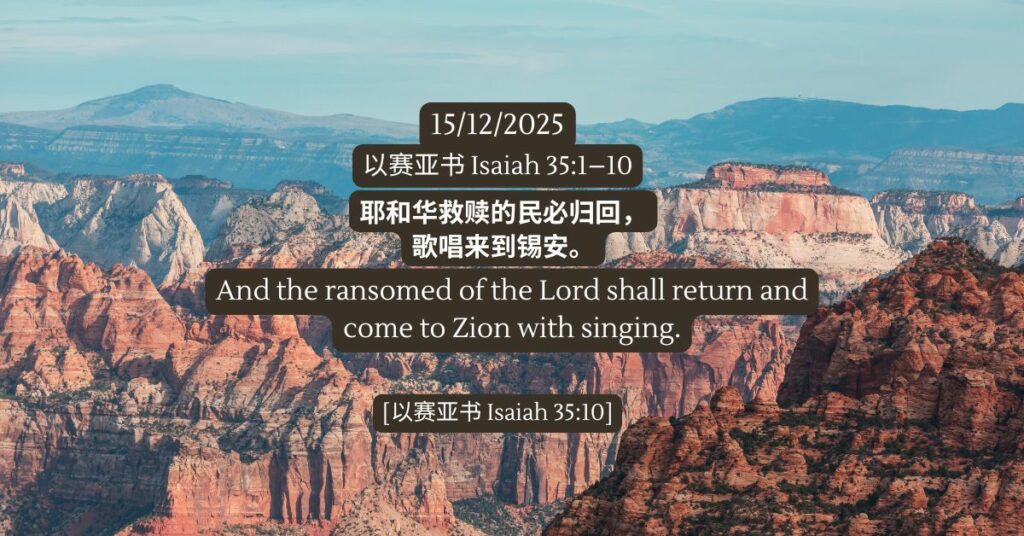
Isaiah 35:1–10
And the ransomed of the Lord shall return and come to Zion with singing. – Isaiah 35:10
Click to Read
Yesterday, on the Lord’s Day, we lit the candle for the third week of Advent, the candle of Joy. There was candlelight in worship, there were hymns, and there was hope. Yet as we step into Monday, the realities of life do not pause. Work pressures, family responsibilities, and inner anxieties remain. After the Advent Sunday of Joy, how do we continue to live in the joy that Jesus gives?
The context of Isaiah 35 is not a time free from trouble. The prophet was addressing a people threatened by foreign powers, facing judgment and impending exile. The nation’s situation was like a desolate wilderness, with no visible way forward. Yet right in the midst of this hardship, God proclaimed a promise of complete reversal: “The wilderness and the dry land shall be glad; the desert shall rejoice and blossom like the crocus” (v. 1). The crocus is a type of flower that symbolises blossoming, joy, and restoration. This verse does not deny suffering, but declares the outcome of God’s redemption even before the wasteland has changed.
Isaiah then paints vivid pictures of renewal: the eyes of the blind shall be opened, the ears of the deaf unstopped; the lame shall leap like a deer, and the tongue of the mute sing for joy; waters shall break forth in the wilderness, and streams in the desert (vv. 5–6). These images point to God’s own intervention, bringing healing and restoration. The joy described here is not emotional excitement, but the strength that comes from God’s presence, enabling the weary to rise and continue their journey.
This passage also sheds light on yesterday’s Gospel reading. In Matthew 11, John the Baptist was not standing amid public acclaim, but imprisoned in a dark cell. The one who had clearly proclaimed Jesus as the Messiah now asked, “Are you the one who is to come?” John’s experience reminds us that true faith and joy do not exclude doubt; rather, they turn toward the Lord even in doubt.
Jesus’ response to John was neither rebuke nor an immediate opening of the prison doors. Instead, He pointed to what was happening: the blind receive sight, the lame walk, and the poor hear good news. These are precisely the signs of salvation foretold in Isaiah. Jesus was assuring John that even in confinement, God’s kingdom was truly at work. This is a deeper joy, not the joy of immediate deliverance, but the assurance that one still belongs within God’s saving plan.
The passage concludes with the image of a “Holy Way,” the road by which God’s redeemed people return home. It promises a sure destination and declares that sorrow and sighing will one day flee away (v. 10). During Advent, we are reminded that we are walking on this very road. Joy is not meant only for Sunday worship, but is to extend into our Monday-to-Saturday lives.
Reflection:
In your present situation that feels like a “wilderness” or a “prison,” are you still willing to trust that God’s salvation is at work? How can you continue walking on the “Holy Way” He has prepared this week?
Prayer:
Lord, as we return to the ordinary and sometimes difficult rhythms of life, grant us a true joy that comes from You. Teach us to trust You in times of doubt, give us strength in weariness, and sustain our hope as we wait. May we walk daily on the path You have prepared, until we find complete joy in You. In Jesus’ name we pray, amen.
Click to Read
Yesterday, on the Lord’s Day, we lit the candle for the third week of Advent, the candle of Joy. There was candlelight in worship, there were hymns, and there was hope. Yet as we step into Monday, the realities of life do not pause. Work pressures, family responsibilities, and inner anxieties remain. After the Advent Sunday of Joy, how do we continue to live in the joy that Jesus gives?
The context of Isaiah 35 is not a time free from trouble. The prophet was addressing a people threatened by foreign powers, facing judgment and impending exile. The nation’s situation was like a desolate wilderness, with no visible way forward. Yet right in the midst of this hardship, God proclaimed a promise of complete reversal: “The wilderness and the dry land shall be glad; the desert shall rejoice and blossom like the crocus” (v. 1). The crocus is a type of flower that symbolises blossoming, joy, and restoration. This verse does not deny suffering, but declares the outcome of God’s redemption even before the wasteland has changed.
Isaiah then paints vivid pictures of renewal: the eyes of the blind shall be opened, the ears of the deaf unstopped; the lame shall leap like a deer, and the tongue of the mute sing for joy; waters shall break forth in the wilderness, and streams in the desert (vv. 5–6). These images point to God’s own intervention, bringing healing and restoration. The joy described here is not emotional excitement, but the strength that comes from God’s presence, enabling the weary to rise and continue their journey.
This passage also sheds light on yesterday’s Gospel reading. In Matthew 11, John the Baptist was not standing amid public acclaim, but imprisoned in a dark cell. The one who had clearly proclaimed Jesus as the Messiah now asked, “Are you the one who is to come?” John’s experience reminds us that true faith and joy do not exclude doubt; rather, they turn toward the Lord even in doubt.
Jesus’ response to John was neither rebuke nor an immediate opening of the prison doors. Instead, He pointed to what was happening: the blind receive sight, the lame walk, and the poor hear good news. These are precisely the signs of salvation foretold in Isaiah. Jesus was assuring John that even in confinement, God’s kingdom was truly at work. This is a deeper joy, not the joy of immediate deliverance, but the assurance that one still belongs within God’s saving plan.
The passage concludes with the image of a “Holy Way,” the road by which God’s redeemed people return home. It promises a sure destination and declares that sorrow and sighing will one day flee away (v. 10). During Advent, we are reminded that we are walking on this very road. Joy is not meant only for Sunday worship, but is to extend into our Monday-to-Saturday lives.
Reflection:
In your present situation that feels like a “wilderness” or a “prison,” are you still willing to trust that God’s salvation is at work? How can you continue walking on the “Holy Way” He has prepared this week?
Prayer:
Lord, as we return to the ordinary and sometimes difficult rhythms of life, grant us a true joy that comes from You. Teach us to trust You in times of doubt, give us strength in weariness, and sustain our hope as we wait. May we walk daily on the path You have prepared, until we find complete joy in You. In Jesus’ name we pray, amen.