
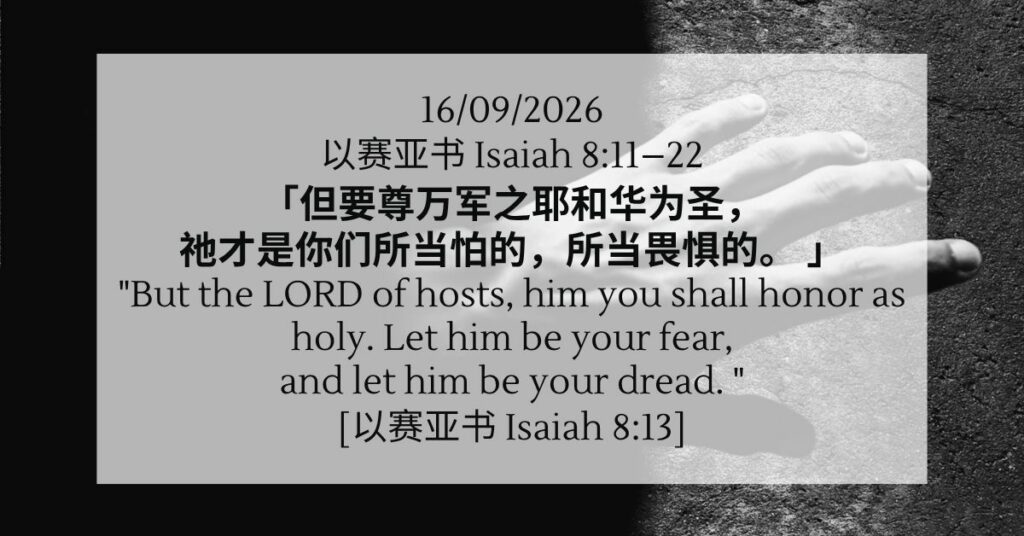
Isaiah 8:11–22
“But the LORD of hosts, him you shall honor as holy. Let him be your fear, and let him be your dread. ” – Isaiah 8:13
Click to read passage
Fear has a way of shaping the choices we make.
In Isaiah’s time, Judah faced threats from all sides. Afraid of Israel and Aram, King Ahaz chose to put his trust in Assyria rather than in God. Assyria seemed to be the answer to Judah’s fears, but it eventually became a far greater threat. What seemed like security would bring destruction.
Against this backdrop, God gives Isaiah a different way to live. He warns Isaiah and his disciples, “Do not fear what they fear, nor be in dread.”(v.12b) Instead, they are to regard the Lord as holy, fear him and trust in Him (v.13).
But trusting God does not mean that everything immediately becomes easier. Assyria is still coming. God’s judgment on His people is still unfolding. Darkness is gathering. And so Isaiah makes a striking declaration: “I will wait for the Lord, who is hiding his face from the house of Jacob, and I will hope in him.” (v.17)
What does it mean to wait for the Lord? It means choosing to trust God when the situation does not yet make sense. Isaiah does not have all the answers, nor does he know exactly how everything will unfold. But he knows whom he can trust. Even when God seems hidden, Isaiah says, “I will hope in him.”
This matters because many other voices competed for God’s people’s attention. Some trusted political alliances. Others sought guidance from mediums and spiritists. Isaiah points them back to God: “Should not a people inquire of their God?”(v.19)
Such temptation is familiar to us. When we are uncertain, we can easily look for security in what everyone else is trusting. We listen to public opinion, the latest news, social media, our own fears, or the advice of those around us. None of these things is necessarily wrong. But they become dangerous when their voices become louder than God’s.
The way of light is different. We listen to God’s Word. We seek His wisdom. We refuse to let the fears of the crowd determine our faith. And when we cannot see clearly what God is doing, we wait for Him. Waiting is not giving up. It is an act of faith. Isaiah’s hope was not ultimately in Judah’s circumstances getting better. His hope was in the Lord Himself.
Perhaps today we need to ask ourselves: When uncertainty comes, where do I instinctively turn? Whose voice shapes my response?
May we pause before following the fears around us. May we return to God’s Word, inquire of Him, and wait for Him. For even when we cannot see the way ahead, we can still say: “I will wait for the LORD… and I will hope in him.”
Reflection:
When I face uncertainty or fear, whose voice do I tend to listen to most?
Prayer:
Dear Lord, when fear surrounds us and the way ahead is unclear, help us not to follow the fears around us. Teach us to listen to Your Word, seek Your wisdom, and wait patiently for You. Even when we cannot see what You are doing, help us to say, “Lord of Hosts, I will hope in You.” In Jesus ’ name, Amen.