
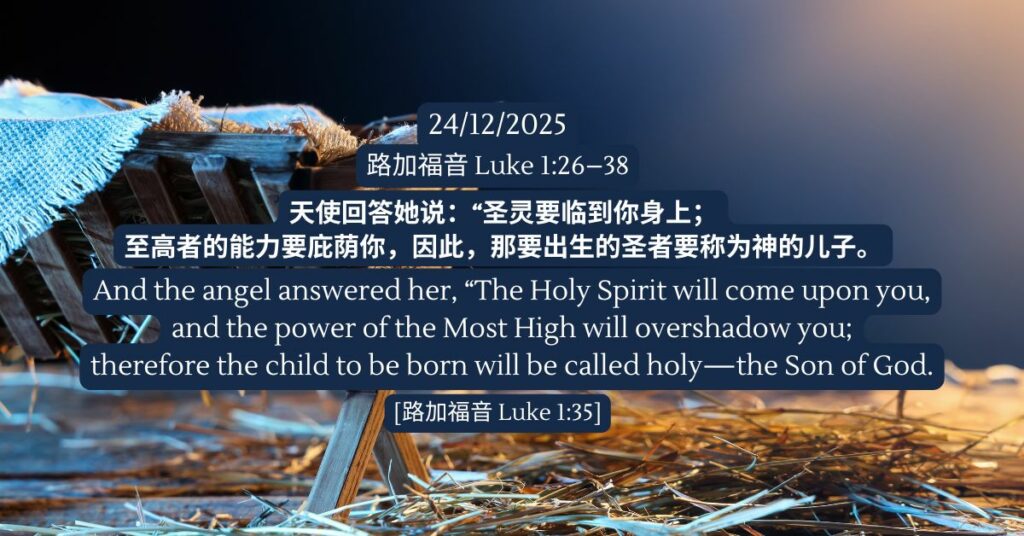
Luke 1:26–38
And the angel answered her, “The Holy Spirit will come upon you, and the power of the Most High will overshadow you; therefore the child to be born will be called holy—the Son of God. – Luke 1:35
Click to read passage
When we read the story of the Annunciation, we often skip straight to Mary’s humble submission. But Luke’s account invites us to sit with her in the messiness of the “before.”
Luke provides a sharp contrast between Mary and Zechariah in chapter 1. Zechariah was a priest, a man of status and age, standing in the holy Temple. Mary was a young, poor girl from a marginalised town. When Gabriel appeared to Zechariah, he was “troubled” (1:12). But when Gabriel spoke to Mary, Luke uses a much stronger word: she was greatly troubled. (1:29)
Mary had every reason to be terrified. In her culture, an unexplained pregnancy didn’t just mean social awkwardness; it meant the potential loss of her reputation, her marriage, and even her life. She was among the most powerless members of society, and the stakes of this “favour” were unimaginably high.
Angel Gabriel tried to reassure her by offering seven grand pronouncements, calling her child the “Son of the Most High” and heir to David’s throne. These titles were both theological and political, directly challenging the Roman Emperor’s claim as the “son of god.” Yet, these magnificent promises didn’t immediately ease Mary’s mind. She didn’t respond with a “Hallelujah,” but with a practical and honest question: “How will this be?” She was navigating the terrifying unknown of her own reality.
What finally moved Mary to complete affirmation—”Let it be to me according to your word”—wasn’t a grand title, but a shared experience. Gabriel revealed that her relative, Elizabeth, had also miraculously conceived.
The assurance that she would not walk this path alone—that another woman understood the weight of God’s intervention—gave Mary the courage to say yes. This is a story of the Incarnation. God does not simply shout promises from a distance; He provides companions. By sending Mary to Elizabeth, and ultimately sending Jesus to us, God proves He is not just a God of “grand announcements,” but a God who shares our lived context.
While the privileged Zechariah was silenced by doubt, the “lowly” Mary was given a song. Faith isn’t the absence of fear; it’s the willingness to step into the unknown because we aren’t walking it alone.
Reflection:
1. Mary was “greatly troubled” by a call that felt risky. Is there a “holy interruption” in your life that feels more like a burden than a blessing? 2. Mary found courage through Elizabeth’s shared journey. Who are the “Elizabeths” in your life, and how can you be that companion for someone else?
Prayer:
Heavenly Father, thank You that You do not demand a “yes” from me without offering Your presence. When I am “greatly troubled” by the unknowns of life, remind me that You journey with me. Give me the courage to ask honest questions and the grace to recognise the companions You place beside me. In Jesus’ name I pray, Amen.
Click to read passage
When we read the story of the Annunciation, we often skip straight to Mary’s humble submission. But Luke’s account invites us to sit with her in the messiness of the “before.”
Luke provides a sharp contrast between Mary and Zechariah in chapter 1. Zechariah was a priest, a man of status and age, standing in the holy Temple. Mary was a young, poor girl from a marginalised town. When Gabriel appeared to Zechariah, he was “troubled” (1:12). But when Gabriel spoke to Mary, Luke uses a much stronger word: she was greatly troubled. (1:29)
Mary had every reason to be terrified. In her culture, an unexplained pregnancy didn’t just mean social awkwardness; it meant the potential loss of her reputation, her marriage, and even her life. She was among the most powerless members of society, and the stakes of this “favour” were unimaginably high.
Angel Gabriel tried to reassure her by offering seven grand pronouncements, calling her child the “Son of the Most High” and heir to David’s throne. These titles were both theological and political, directly challenging the Roman Emperor’s claim as the “son of god.” Yet, these magnificent promises didn’t immediately ease Mary’s mind. She didn’t respond with a “Hallelujah,” but with a practical and honest question: “How will this be?” She was navigating the terrifying unknown of her own reality.
What finally moved Mary to complete affirmation—”Let it be to me according to your word”—wasn’t a grand title, but a shared experience. Gabriel revealed that her relative, Elizabeth, had also miraculously conceived.
The assurance that she would not walk this path alone—that another woman understood the weight of God’s intervention—gave Mary the courage to say yes. This is a story of the Incarnation. God does not simply shout promises from a distance; He provides companions. By sending Mary to Elizabeth, and ultimately sending Jesus to us, God proves He is not just a God of “grand announcements,” but a God who shares our lived context.
While the privileged Zechariah was silenced by doubt, the “lowly” Mary was given a song. Faith isn’t the absence of fear; it’s the willingness to step into the unknown because we aren’t walking it alone.
Reflection:
1. Mary was “greatly troubled” by a call that felt risky. Is there a “holy interruption” in your life that feels more like a burden than a blessing? 2. Mary found courage through Elizabeth’s shared journey. Who are the “Elizabeths” in your life, and how can you be that companion for someone else?
Prayer:
Heavenly Father, thank You that You do not demand a “yes” from me without offering Your presence. When I am “greatly troubled” by the unknowns of life, remind me that You journey with me. Give me the courage to ask honest questions and the grace to recognise the companions You place beside me. In Jesus’ name I pray, Amen.