
Numbers 12
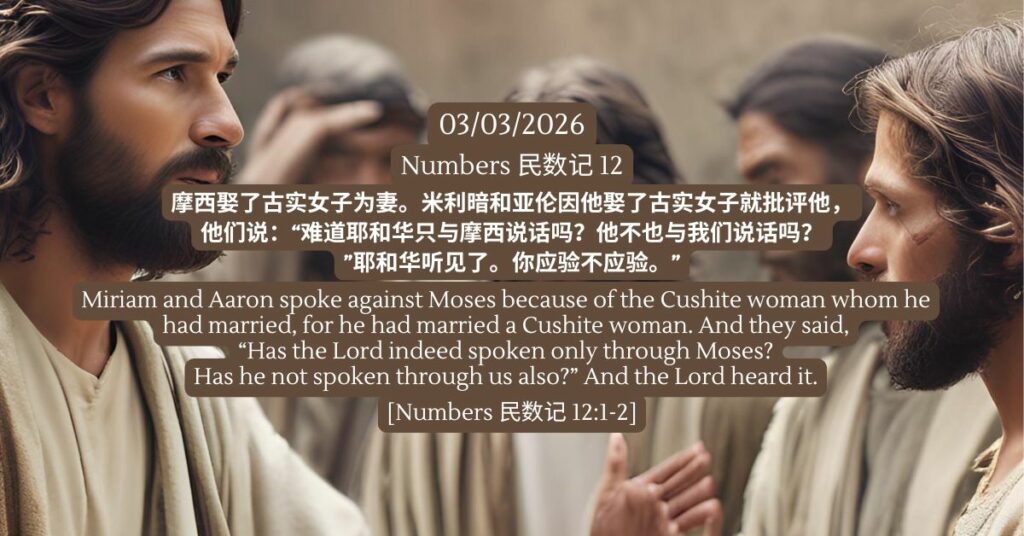
Miriam and Aaron spoke against Moses because of the Cushite woman whom he had married, for he had married a Cushite woman. 2And they said, “Has the Lord indeed spoken only through Moses? Has he not spoken through us also?” And the Lord heard it. – Numbers 12:1-2
Click to readd passage
The incident in Numbers 12 reflects problems that can easily recur in churches today.
After receiving instructions in Numbers 1–10, the Israelites begin travelling from Mount Sinai, where they had camped for about a year. Complaints quickly arise in Numbers 11 when the people lack food and water, though God graciously provides. In Numbers 12, Miriam and Aaron criticise Moses for marrying an Ethiopian woman. They then challenge his spiritual authority (v.2). Instead of supporting Moses after the earlier rebellion, they question and undermine him. Perhaps they assumed that, because Moses was meek and humble, he would not respond strongly.
Why did they do this? Though the text does not explicitly say, jealousy and envy seem likely. God had spoken through them as well (Exo 4:30; 12:1; 15:20–21), so why was Moses receiving the leadership role? They may have reasoned, “God speaks through us too. Therefore, Moses should share his place of authority over the congregation of Israel with us. Why is he taking all the spotlight and decisions?” The issue of Moses’ marriage may simply have provided a convenient excuse.
Was Moses given “special favour” to allow him to get away from intermarriage? I believe not. While no specific reason was given in the text, it is very clear that God had appointed Moses as the leader of the Israelites, even with this marriage in place. The law that prohibited marriage with non-Israelites was (1) given much later in the wilderness journey, in Deuteronomy; (2) focused on the inhabitants of the promised land (and not Ethiopia) that were driven out (Deut 7:1), and (3) was given to prevent corruption of character, of which God strongly defended Moses character in Number 12:6-8.
As we reflect on this passage, we should not allow such attitudes of jealousy and pride to affect our relationship with our fellow brothers and sisters in Christ. We should not be concerned with who God chooses to honour or put in the forefront of the church. Shouldn’t our attitude be like John the Baptist, who said that Jesus must increase, and He himself must decrease, in John 3? We need to work together in unity, seeking to complement each other if and when problems arise. How lovely it would have been if Miriam, Aaron, and Moses had been united in working together, supporting each other against the Israelites’ rebellion in Numbers chapter 11?
Finally, consider Moses’ attitude toward his sister despite her behaviour. After being struck by leprosy, Moses earnestly pleaded with God for her healing. And when the final healing was known to take 7 days, the whole of Israel, more than 600,000, waited for her to be well before resuming their journey. What a wonderful level of care and concern for Miriam!
Reflection:
Are there hidden attitudes of envy, pride or jealousy in your relationship with your fellow brothers and sisters in Christ? Are you concerned that you are not receiving the acknowledgement you think you deserve for your service for Christ? How can I grow in humility? How can I learn to honour others in Christ?
Prayer:
Father, I thank you for the wonderful, instructive story in Numbers chapter 12. Help us guard against pride, envy, and jealousy, which can often be so subtle and hidden. I pray for the leadership in Foochow Methodist Church, for love and unity and a spirit of humility. Help them lead the church harmoniously, and help us all play our parts, complementing each other in our walk and service in Christ. In Jesus’ name we pray, Amen.
Click to readd passage
The incident in Numbers 12 reflects problems that can easily recur in churches today.
After receiving instructions in Numbers 1–10, the Israelites begin travelling from Mount Sinai, where they had camped for about a year. Complaints quickly arise in Numbers 11 when the people lack food and water, though God graciously provides. In Numbers 12, Miriam and Aaron criticise Moses for marrying an Ethiopian woman. They then challenge his spiritual authority (v.2). Instead of supporting Moses after the earlier rebellion, they question and undermine him. Perhaps they assumed that, because Moses was meek and humble, he would not respond strongly.
Why did they do this? Though the text does not explicitly say, jealousy and envy seem likely. God had spoken through them as well (Exo 4:30; 12:1; 15:20–21), so why was Moses receiving the leadership role? They may have reasoned, “God speaks through us too. Therefore, Moses should share his place of authority over the congregation of Israel with us. Why is he taking all the spotlight and decisions?” The issue of Moses’ marriage may simply have provided a convenient excuse.
Was Moses given “special favour” to allow him to get away from intermarriage? I believe not. While no specific reason was given in the text, it is very clear that God had appointed Moses as the leader of the Israelites, even with this marriage in place. The law that prohibited marriage with non-Israelites was (1) given much later in the wilderness journey, in Deuteronomy; (2) focused on the inhabitants of the promised land (and not Ethiopia) that were driven out (Deut 7:1), and (3) was given to prevent corruption of character, of which God strongly defended Moses character in Number 12:6-8.
As we reflect on this passage, we should not allow such attitudes of jealousy and pride to affect our relationship with our fellow brothers and sisters in Christ. We should not be concerned with who God chooses to honour or put in the forefront of the church. Shouldn’t our attitude be like John the Baptist, who said that Jesus must increase, and He himself must decrease, in John 3? We need to work together in unity, seeking to complement each other if and when problems arise. How lovely it would have been if Miriam, Aaron, and Moses had been united in working together, supporting each other against the Israelites’ rebellion in Numbers chapter 11?
Finally, consider Moses’ attitude toward his sister despite her behaviour. After being struck by leprosy, Moses earnestly pleaded with God for her healing. And when the final healing was known to take 7 days, the whole of Israel, more than 600,000, waited for her to be well before resuming their journey. What a wonderful level of care and concern for Miriam!
Reflection:
Are there hidden attitudes of envy, pride or jealousy in your relationship with your fellow brothers and sisters in Christ? Are you concerned that you are not receiving the acknowledgement you think you deserve for your service for Christ? How can I grow in humility? How can I learn to honour others in Christ?
Prayer:
Father, I thank you for the wonderful, instructive story in Numbers chapter 12. Help us guard against pride, envy, and jealousy, which can often be so subtle and hidden. I pray for the leadership in Foochow Methodist Church, for love and unity and a spirit of humility. Help them lead the church harmoniously, and help us all play our parts, complementing each other in our walk and service in Christ. In Jesus’ name we pray, Amen.