
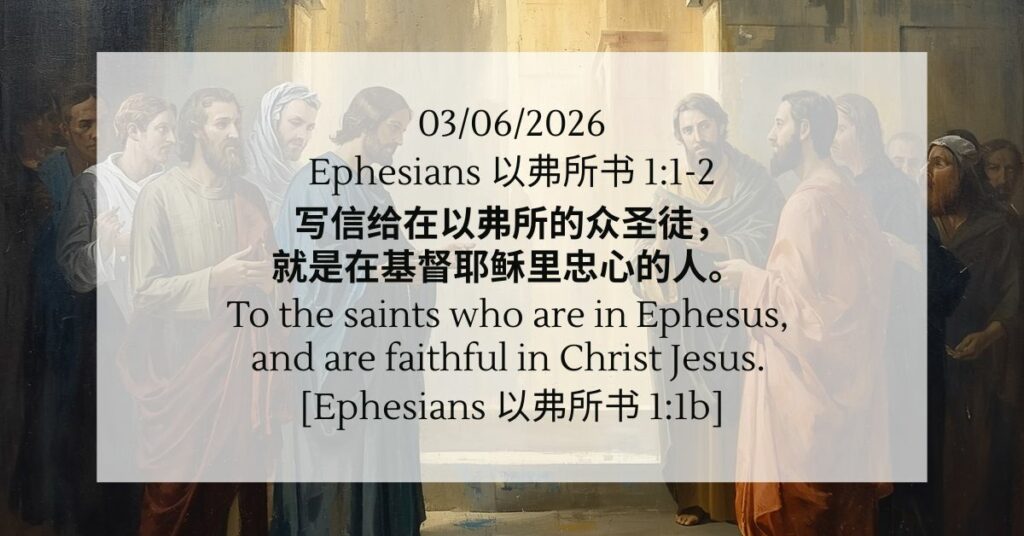
Ephesians 1:1-2
To the saints who are in Ephesus, and are faithful in Christ Jesus. – Ephesians 1:1b
Click to read passage
Yesterday we completed our reading of Colossians, and today we begin our journey through Ephesians. This letter will continually remind us of who we are and of the rich spiritual blessings we have in Christ. The book of Ephesians is one of Paul’s most encouraging letters. Unlike some of his other letters, this letter did not address a major crisis or correct false teaching. Instead, he wrote to strengthen believers by reminding them of who they are in Christ and how they should live in light of that identity.
A key phrase throughout the letter is “in Christ.” More than any other Pauline letter, Ephesians emphasises our union with Christ. Paul teaches that believers have been chosen, redeemed, adopted, forgiven, and blessed because they are united with Jesus. The first half of the letter (chapters 1–3) focuses on what God has done for us; the second half (chapters 4–6) focuses on how we should respond through holy living, unity, love, and spiritual maturity. Another major theme is the church as the Body of Christ. God is creating a new people, united across every barrier, to display His wisdom and glory to the world.
In the first two verses of Ephesians we read today, Paul begins his letter with a simple greeting. At first glance, these words may seem like a standard introduction. Yet they contain profound truths about our identity and God’s heart for His people. Paul reminds the believers that he is an apostle “by the will of God.” His ministry was not self-appointed nor based on personal ambition. It was rooted in God’s calling and purpose. In the same way, our identity is not ultimately determined by our achievements, failures, or others’ opinions. It begins with what God has graciously done for us.
Paul addresses the believers as “saints.” Today, we often reserve that word for exceptionally holy people, but in Scripture, every believer is called a saint. A saint is simply someone whom God has set apart for Himself. This does not mean believers are perfect; rather, it means they belong to God. Their position before Him is secure because of Christ.
At the same time, Paul calls them “faithful” in Christ Jesus. They lived in Ephesus physically, but spiritually they were “in Christ.” As mentioned earlier, this is one of the most important themes in Ephesians. Their true identity was not found in their city, culture, status, or background, but in their relationship with Jesus. Because they were united with Christ, His blessings became theirs. His righteousness, acceptance, and inheritance now belonged to them.
Paul then prays that grace and peace would be theirs. Grace is God’s undeserved favour; peace is the wholeness and security that flow from being reconciled to God through Christ. Notice that both come from God the Father and the Lord Jesus Christ. These are not things we earn but gifts we receive.
Many Christians struggle with feelings of inadequacy and focus primarily on their weaknesses and failures. Over time, this can weaken our desire and confidence to live out the calling God has given us. We may feel unworthy to serve, hesitant to step out in faith, or discouraged in our pursuit of holiness. Yet Paul begins by reminding the Ephesians, and all who are in Christ, not of what we lack, but of who we are.
Brothers and sisters, this is not positive thinking or self-help optimism. Paul is not telling believers to think more highly of themselves, but to see themselves through the lens of God’s grace. We are saints because God has set us apart for Himself. We are faithful ones in Christ because we belong to Him. We are recipients of God’s grace and peace. Our confidence for Christian living does not come from our own strength, but from our identity and standing in Christ.
Reflection:
Do I define myself by my shortcomings, or by my identity in Christ? Ask the Lord to help you rest in His grace, walk in His peace, and live faithfully as one whom He has set apart for His purposes.
Prayer:
Heavenly Father, thank You that my identity is found not in my performance but in Christ. Thank You for calling me Your own and setting me apart for Your purposes. Help me to live faithfully in Christ as Your child, resting in Your grace and peace each day. In Jesus’ name I pray, Amen.
Click to read passage
Yesterday we completed our reading of Colossians, and today we begin our journey through Ephesians. This letter will continually remind us of who we are and of the rich spiritual blessings we have in Christ. The book of Ephesians is one of Paul’s most encouraging letters. Unlike some of his other letters, this letter did not address a major crisis or correct false teaching. Instead, he wrote to strengthen believers by reminding them of who they are in Christ and how they should live in light of that identity.
A key phrase throughout the letter is “in Christ.” More than any other Pauline letter, Ephesians emphasises our union with Christ. Paul teaches that believers have been chosen, redeemed, adopted, forgiven, and blessed because they are united with Jesus. The first half of the letter (chapters 1–3) focuses on what God has done for us; the second half (chapters 4–6) focuses on how we should respond through holy living, unity, love, and spiritual maturity. Another major theme is the church as the Body of Christ. God is creating a new people, united across every barrier, to display His wisdom and glory to the world.
In the first two verses of Ephesians we read today, Paul begins his letter with a simple greeting. At first glance, these words may seem like a standard introduction. Yet they contain profound truths about our identity and God’s heart for His people. Paul reminds the believers that he is an apostle “by the will of God.” His ministry was not self-appointed nor based on personal ambition. It was rooted in God’s calling and purpose. In the same way, our identity is not ultimately determined by our achievements, failures, or others’ opinions. It begins with what God has graciously done for us.
Paul addresses the believers as “saints.” Today, we often reserve that word for exceptionally holy people, but in Scripture, every believer is called a saint. A saint is simply someone whom God has set apart for Himself. This does not mean believers are perfect; rather, it means they belong to God. Their position before Him is secure because of Christ.
At the same time, Paul calls them “faithful” in Christ Jesus. They lived in Ephesus physically, but spiritually they were “in Christ.” As mentioned earlier, this is one of the most important themes in Ephesians. Their true identity was not found in their city, culture, status, or background, but in their relationship with Jesus. Because they were united with Christ, His blessings became theirs. His righteousness, acceptance, and inheritance now belonged to them.
Paul then prays that grace and peace would be theirs. Grace is God’s undeserved favour; peace is the wholeness and security that flow from being reconciled to God through Christ. Notice that both come from God the Father and the Lord Jesus Christ. These are not things we earn but gifts we receive.
Many Christians struggle with feelings of inadequacy and focus primarily on their weaknesses and failures. Over time, this can weaken our desire and confidence to live out the calling God has given us. We may feel unworthy to serve, hesitant to step out in faith, or discouraged in our pursuit of holiness. Yet Paul begins by reminding the Ephesians, and all who are in Christ, not of what we lack, but of who we are.
Brothers and sisters, this is not positive thinking or self-help optimism. Paul is not telling believers to think more highly of themselves, but to see themselves through the lens of God’s grace. We are saints because God has set us apart for Himself. We are faithful ones in Christ because we belong to Him. We are recipients of God’s grace and peace. Our confidence for Christian living does not come from our own strength, but from our identity and standing in Christ.
Reflection:
Do I define myself by my shortcomings, or by my identity in Christ? Ask the Lord to help you rest in His grace, walk in His peace, and live faithfully as one whom He has set apart for His purposes.
Prayer:
Heavenly Father, thank You that my identity is found not in my performance but in Christ. Thank You for calling me Your own and setting me apart for Your purposes. Help me to live faithfully in Christ as Your child, resting in Your grace and peace each day. In Jesus’ name I pray, Amen.