
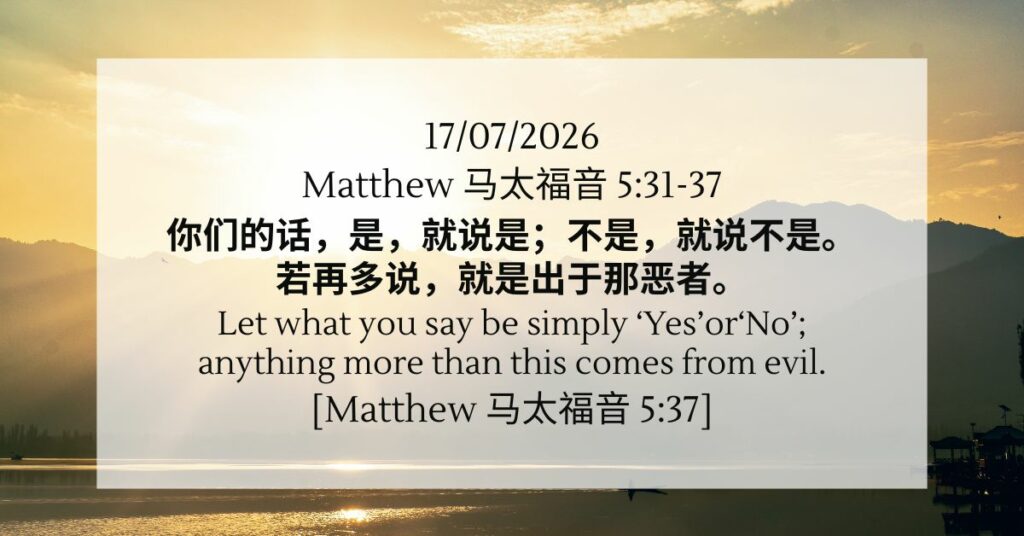
Matthew 5:31-37
Let what you say be simply ‘Yes’or‘No’; anything more than this comes from evil. – Matthew 5:37
Click to read passage
In this passage, the Lord Jesus draws on the Old Testament law to address two topics: divorce and oaths.
On the law, Jesus said, “I have not come to abolish them but to fulfill them” (Matthew 5:17b).
The law said, “Whoever divorces his wife must give her a certificate of divorce.” Jesus said, “But I say to you that everyone who divorces his wife, except on the ground of sexual immorality, makes her commit adultery, and whoever marries a divorced woman commits adultery” (Matthew 5:31-32).
What was the true intent behind this ordinance? Turn back to Deuteronomy: “When a man takes a wife and marries her, if then she finds no favor in his eyes because he has found some indecency in her, and he writes her a certificate of divorce and puts it in her hand and sends her out of his house…” (Deuteronomy 24:1). Moses required that if a husband found “some indecency” in his wife, he give her a certificate of divorce. What counted as “indecency”? Jewish tradition differed: conservative schools took it to mean serious sexual immorality, while more lenient ones held that anything a husband found displeasing — even burnt food, or criticising his parents — could count. Yet Moses required the certificate to be placed in her hand, and in that social context, this was actually a legal protection for the woman. Without it, a divorced woman risked being treated as an adulteress, facing social rejection or even punishment. With it, she was legally free, able to remarry without being regarded as guilty of adultery.
It is hard to find any example in Scripture that approves of divorce. What we find instead is God’s blessing on marriage and His concern for its holiness.
And yet, from the Jewish people of old to modern society, divorce has not declined with social progress; even within the church, it remains far from rare. This shows us plainly how Adam’s fallen nature keeps repeating itself in us — walking the path of rebellion while making excuses for our own conduct.
What is true of marriage is also true of oaths.
The Jewish people believed that as long as they did not swear directly by the Lord’s name, they were not bound to keep their word. But they missed the fact that heaven and earth and all things belong to God, for He made them all. Jesus said, “Let what you say be simply ‘Yes’ or ‘No’; anything more than this comes from evil” (Matthew 5:37). True citizens of the kingdom of heaven are rooted in inward honesty and need no oath to prove themselves. God Himself is our best witness; if we keep His word continually in our hearts, knowing that He watches over all our conduct, we will not dare deceive others — still less deceive Him.
We have become citizens of the kingdom of heaven not by our own works, but by the strength the Lord Jesus gives us, reminding and helping us to live out a life of repentance, so that our hearts are willing to live out the true spirit of the law — not mere outward conduct, but inward holiness. Only when our hearts are governed by God can we, whether at home, at work, or in society, live through reverence and obedience toward Him a life that surpasses and fulfils what the law requires — so that His glory is displayed in us, and we become truly blessed people.
Reflection:
In my daily life, am I content with merely getting the “form” right, while neglecting the reality underneath? Am I willing today to return to a right relationship with the Lord, so that my marriage and relationships may be blessed by Him?
Prayer:
Dear Lord Jesus, thank You for using the teaching of the Sermon on the Mount to bring us back again to Your word, and to remove from our lives whatever is merely outward form. Lord, grant us a heart of reverence and obedience, that we may live lives of sincerity, blessed by You. We pray in Your precious name, Amen!
Click to read passage
In this passage, the Lord Jesus draws on the Old Testament law to address two topics: divorce and oaths.
On the law, Jesus said, “I have not come to abolish them but to fulfill them” (Matthew 5:17b).
The law said, “Whoever divorces his wife must give her a certificate of divorce.” Jesus said, “But I say to you that everyone who divorces his wife, except on the ground of sexual immorality, makes her commit adultery, and whoever marries a divorced woman commits adultery” (Matthew 5:31-32).
What was the true intent behind this ordinance? Turn back to Deuteronomy: “When a man takes a wife and marries her, if then she finds no favor in his eyes because he has found some indecency in her, and he writes her a certificate of divorce and puts it in her hand and sends her out of his house…” (Deuteronomy 24:1). Moses required that if a husband found “some indecency” in his wife, he give her a certificate of divorce. What counted as “indecency”? Jewish tradition differed: conservative schools took it to mean serious sexual immorality, while more lenient ones held that anything a husband found displeasing — even burnt food, or criticising his parents — could count. Yet Moses required the certificate to be placed in her hand, and in that social context, this was actually a legal protection for the woman. Without it, a divorced woman risked being treated as an adulteress, facing social rejection or even punishment. With it, she was legally free, able to remarry without being regarded as guilty of adultery.
It is hard to find any example in Scripture that approves of divorce. What we find instead is God’s blessing on marriage and His concern for its holiness.
And yet, from the Jewish people of old to modern society, divorce has not declined with social progress; even within the church, it remains far from rare. This shows us plainly how Adam’s fallen nature keeps repeating itself in us — walking the path of rebellion while making excuses for our own conduct.
What is true of marriage is also true of oaths.
The Jewish people believed that as long as they did not swear directly by the Lord’s name, they were not bound to keep their word. But they missed the fact that heaven and earth and all things belong to God, for He made them all. Jesus said, “Let what you say be simply ‘Yes’ or ‘No’; anything more than this comes from evil” (Matthew 5:37). True citizens of the kingdom of heaven are rooted in inward honesty and need no oath to prove themselves. God Himself is our best witness; if we keep His word continually in our hearts, knowing that He watches over all our conduct, we will not dare deceive others — still less deceive Him.
We have become citizens of the kingdom of heaven not by our own works, but by the strength the Lord Jesus gives us, reminding and helping us to live out a life of repentance, so that our hearts are willing to live out the true spirit of the law — not mere outward conduct, but inward holiness. Only when our hearts are governed by God can we, whether at home, at work, or in society, live through reverence and obedience toward Him a life that surpasses and fulfils what the law requires — so that His glory is displayed in us, and we become truly blessed people.
Reflection:
In my daily life, am I content with merely getting the “form” right, while neglecting the reality underneath? Am I willing today to return to a right relationship with the Lord, so that my marriage and relationships may be blessed by Him?
Prayer:
Dear Lord Jesus, thank You for using the teaching of the Sermon on the Mount to bring us back again to Your word, and to remove from our lives whatever is merely outward form. Lord, grant us a heart of reverence and obedience, that we may live lives of sincerity, blessed by You. We pray in Your precious name, Amen!