
Isaiah 7:10–17
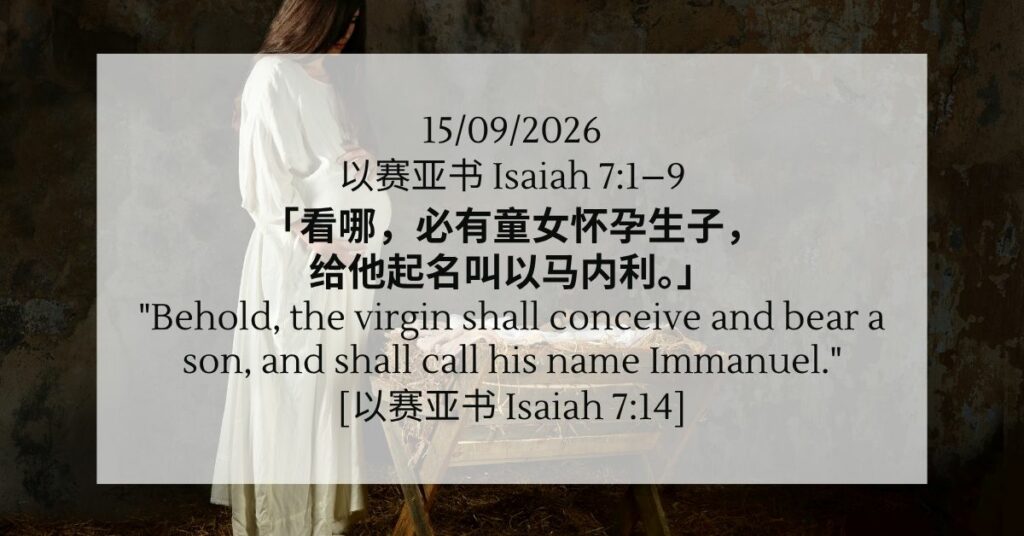
“Behold, the virgin shall conceive and bear a son, and shall call his name Immanuel.” – Isaiah 7:14
Click to read passage
Our text has as its backdrop the kings of Syria and Israel joining forces to attack Judah. Out of His faithfulness to the house of David, God sent Isaiah to assure Ahaz, King of Judah, that his enemies’ plans will fail. And to reinforce Ahaz’s confidence, God offered to show him a sign – whatever sign he might ask. Anyone in such a dire strait will jump at the offer. But ironically Ahaz turned it down, insisting that he would not put God to the test in accordance with Moses’ instructions (see Deuteronomy 6:16).
But Ahaz’s explanation was no more than an excuse because, since God had offered him a sign, he cannot be said to be testing Him if he asked for one. In fact, the reverse is true. Ahaz was in fact practising false piety. Ahaz’s true reason was that he had already enlisted the help of the Assyrian king (2 Kings 16:7) and therefore thought he was secure. He chose to plead meekly with the king of Assyria, “I am your servant and your son. Come up and rescue me” (2 Kings 16:7), but foolishly rejected God’s generous offer to him.
In response, Isaiah asked Ahaz pointedly, “Is it not enough to try the patience of humans? Will you try the patience of my God also?” (Isaiah 7:13). Despite Ahaz’s refusal to ask God for a sign, God gave him one anyway: a sign that “the virgin shall conceive and bear a son, and shall call his name Immanuel” (Isaiah 7:14b), which was ultimately fulfilled when Christ came into the world.
At first glance, the transition from Ahaz’s refusal to ask God for a sign to the prophecy of the virgin birth seems rather abrupt and confusing. But what we are being shown is a sharp contrast between the terrible choice Ahaz made and the wonderful offer of Immanuel promised by God. The help Ahaz sought was from mortal man, but God offered the immortal Immanuel. Whereas the Assyrian army was far away from Judah, Immanuel, God with us, is ever near. Whereas man will fail us, God will not.
God was effectively giving Ahaz Good News of deliverance from his enemies, which sadly Ahaz flatly rejected. Unfortunately, man’s folly is not limited to Ahaz. Today, many continue to count on human endeavours to live their lives instead of accepting God’s grace and love. In this season of “GO”, we are reminded that like Isaiah, whom God used to convey His marvellous offer to Ahaz, we too are called to bring His Good News to the world, so that many may avoid the same tragic mistakes made by Ahaz.
Reflections:
Apart from refusing to trust God, Ahaz made at least two other grave mistakes that we must be wary of.
Ahaz misjudged the urgency and severity of the threats he faced. Like the rich fool in Luke’s parable who tore down his barns to build bigger ones, thinking he could “”take life easy, eat, drink and be merry””, only to hear “”You fool! This very night your life will be demanded from you”” (see Luke 12:13 – 21), we too can be lulled into complacency. Where might I be ignoring the uncertainties of life instead of taking them seriously before God?
Ahaz thought he could fool God through his false piety, but the psalmist warns that God can perceive our thoughts from afar (Ps 139:2). Am I ever putting up a false front before God instead of honestly bringing Him my concerns and doubts?
Ahaz’s mistakes carried consequences. Even the Assyrian king he depended on eventually turned against him (see 2 Chronicles 28:20), as Isaiah had prophesied in verse 17. Where in my life am I trusting in something or someone other than God, and what might that choice eventually cost me?
Prayer:
Almighty God, thank you for your great love for the world despite its constant rebellion and disobedience towards you. In this season of “go”, would you, Lord, lay on our hearts the same burden that is on yours – to bring your Good News to a world that is blinded by the pride of human achievements and deluded into believing that it does not need you. Have mercy, Lord, have mercy. May we answer your call in the same way as Isaiah, who, when you asked, “Whom shall I send?”, answered, “Here am I. Send me”. In Jesus’ mighty Name we pray