
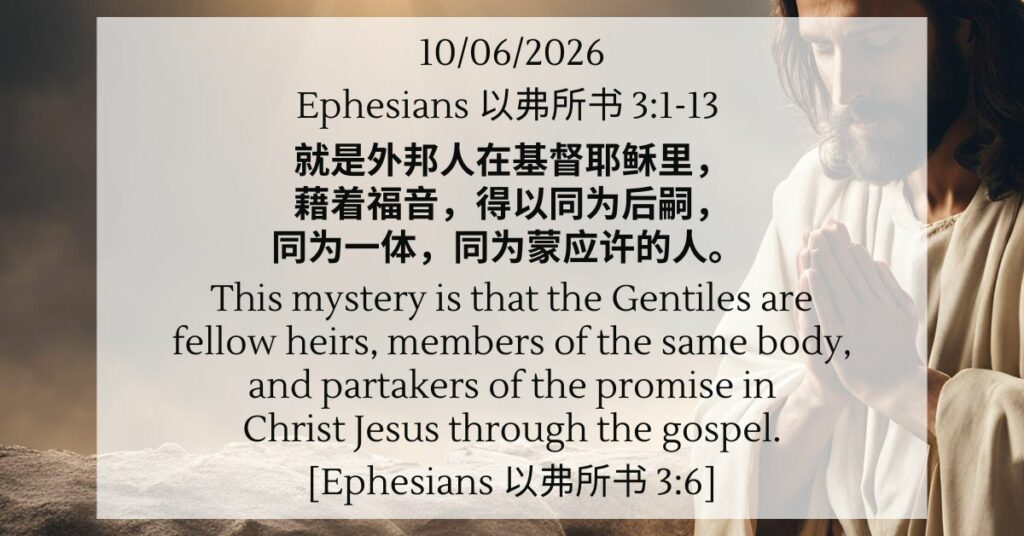
Ephesians 3:1-13
This mystery is that the Gentiles are fellow heirs, members of the same body, and partakers of the promise in Christ Jesus through the gospel. – Ephesians 3:6
Please click to read passage
When we think about our relationship with the gospel of Jesus Christ, we often focus on what it does for us—how it saves us, forgives us, and gives us hope. But in Ephesians 3:1–13, Paul invites us to see another dimension of the gospel: not only as a gift we receive, but also as a trust we steward. Most of us readily see ourselves as beneficiaries of the gospel, but Paul invites us to see ourselves as stewards of the gospel as well.
Paul describes himself as “a prisoner of Christ Jesus for the sake of you Gentiles” (v. 1). Interestingly, he does not call himself a prisoner of Rome, though he was literally under Roman custody. Instead, he sees his circumstances through the lens of God’s purpose. His life belongs to Christ, and even his suffering is connected to the mission Christ has entrusted to him.
Paul’s imprisonment was not a setback but part of his stewardship of the gospel. His chains became a means through which the Gentiles heard the good news, showing that faithful stewardship often involves suffering for the sake of others (cf. Philippians 1:29). As he later reminds the Ephesians, “So I ask you not to be discouraged because of my sufferings for you, which are your glory” (Ephesians 3:13).
Throughout this passage, Paul repeatedly speaks of stewardship. He says that God’s grace was given to him to make known the “mystery of Christ” (vv. 2–6). This mystery, once hidden but now revealed, is that Gentiles and Jews are equal heirs, members of the same body, and sharers together in God’s promises through the gospel.
Paul does not view this revelation as a personal achievement. In fact, he describes himself as “less than the least of all the Lord’s people” (v. 8). Yet despite his unworthiness, God entrusted him with the privilege of proclaiming the “boundless riches of Christ.” Paul understood that ministry was not something he earned; it was a gift of grace. What is striking is that Paul’s sense of insignificance did not lead to passivity. Instead, it led to gratitude and faithful service. He was amazed that God would use someone like him to participate in His eternal plan. Even his imprisonment could not diminish his sense of calling.
Paul also reminds us that the gospel has a much larger purpose than we often imagine. Through the church, God’s manifold wisdom is being displayed to the rulers and authorities in the heavenly realms (v. 10). In other words, when God’s people live together in unity, proclaim Christ, and walk in faithfulness, they become living evidence of God’s wisdom before the entire universe.
Finally, Paul points believers to the confidence they now possess in Christ. Because of Jesus, we have freedom and boldness to approach God (v. 12). The same God who entrusted Paul with His mission also welcomes us into His presence. Brothers and sisters, we may feel ordinary or inadequate, yet God’s calling does not rest on our worthiness but on His grace. The gospel that has transformed our lives is also a message entrusted to us. May we faithfully make Christ known wherever He has placed us.
Reflection:
1. How does Paul’s description of himself as a “prisoner of Christ” change the way you view difficult circumstances?
2. In what ways has God entrusted you to make Christ known to others? What step of faith can you take this week to share the boundless riches of Christ with someone around you?
Prayer:
Dear Lord Jesus, thank You for saving us and entrusting us with the good news of Your grace. Like Paul, help us to serve You with humility and faithfulness, trusting not in our own abilities but in Your power at work through us. Give us courage to make Christ known and confidence to draw near to You each day. In Jesus’s name we pray, Amen.
Please click to read passage
When we think about our relationship with the gospel of Jesus Christ, we often focus on what it does for us—how it saves us, forgives us, and gives us hope. But in Ephesians 3:1–13, Paul invites us to see another dimension of the gospel: not only as a gift we receive, but also as a trust we steward. Most of us readily see ourselves as beneficiaries of the gospel, but Paul invites us to see ourselves as stewards of the gospel as well.
Paul describes himself as “a prisoner of Christ Jesus for the sake of you Gentiles” (v. 1). Interestingly, he does not call himself a prisoner of Rome, though he was literally under Roman custody. Instead, he sees his circumstances through the lens of God’s purpose. His life belongs to Christ, and even his suffering is connected to the mission Christ has entrusted to him.
Paul’s imprisonment was not a setback but part of his stewardship of the gospel. His chains became a means through which the Gentiles heard the good news, showing that faithful stewardship often involves suffering for the sake of others (cf. Philippians 1:29). As he later reminds the Ephesians, “So I ask you not to be discouraged because of my sufferings for you, which are your glory” (Ephesians 3:13).
Throughout this passage, Paul repeatedly speaks of stewardship. He says that God’s grace was given to him to make known the “mystery of Christ” (vv. 2–6). This mystery, once hidden but now revealed, is that Gentiles and Jews are equal heirs, members of the same body, and sharers together in God’s promises through the gospel.
Paul does not view this revelation as a personal achievement. In fact, he describes himself as “less than the least of all the Lord’s people” (v. 8). Yet despite his unworthiness, God entrusted him with the privilege of proclaiming the “boundless riches of Christ.” Paul understood that ministry was not something he earned; it was a gift of grace. What is striking is that Paul’s sense of insignificance did not lead to passivity. Instead, it led to gratitude and faithful service. He was amazed that God would use someone like him to participate in His eternal plan. Even his imprisonment could not diminish his sense of calling.
Paul also reminds us that the gospel has a much larger purpose than we often imagine. Through the church, God’s manifold wisdom is being displayed to the rulers and authorities in the heavenly realms (v. 10). In other words, when God’s people live together in unity, proclaim Christ, and walk in faithfulness, they become living evidence of God’s wisdom before the entire universe.
Finally, Paul points believers to the confidence they now possess in Christ. Because of Jesus, we have freedom and boldness to approach God (v. 12). The same God who entrusted Paul with His mission also welcomes us into His presence. Brothers and sisters, we may feel ordinary or inadequate, yet God’s calling does not rest on our worthiness but on His grace. The gospel that has transformed our lives is also a message entrusted to us. May we faithfully make Christ known wherever He has placed us.
Reflection:
1. How does Paul’s description of himself as a “prisoner of Christ” change the way you view difficult circumstances?
2. In what ways has God entrusted you to make Christ known to others? What step of faith can you take this week to share the boundless riches of Christ with someone around you?
Prayer:
Dear Lord Jesus, thank You for saving us and entrusting us with the good news of Your grace. Like Paul, help us to serve You with humility and faithfulness, trusting not in our own abilities but in Your power at work through us. Give us courage to make Christ known and confidence to draw near to You each day. In Jesus’s name we pray, Amen.