
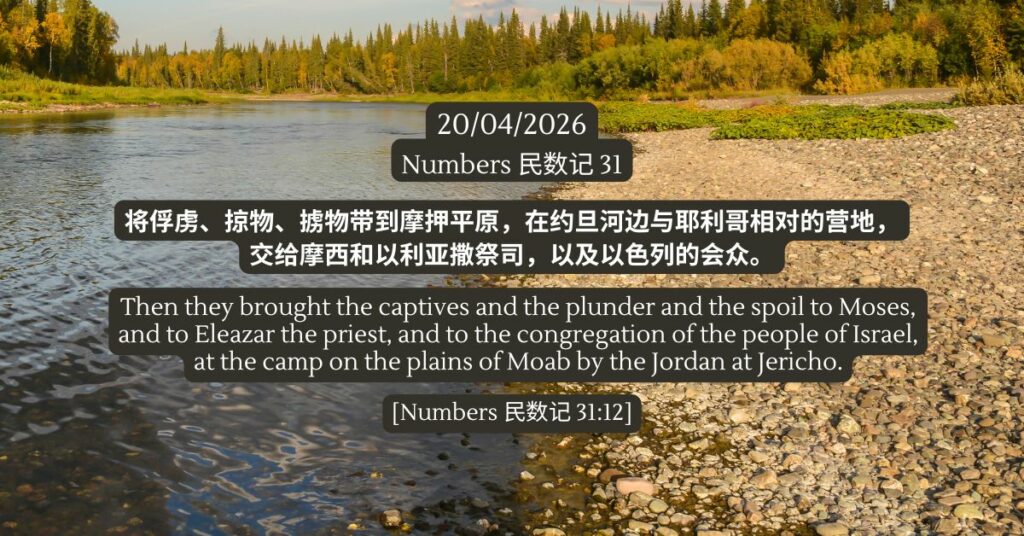
Numbers 31
Then they brought the captives and the plunder and the spoil to Moses, and to Eleazar the priest, and to the congregation of the people of Israel, at the camp on the plains of Moab by the Jordan at Jericho. – Numbers 31:12
Click to read passage
Numbers 31 records Israel’s battle against the Midianites. This passage can feel uncomfortable to read: why does God command “vengeance”? Why is the destruction so complete? In today’s world, filled with conflict, it can easily be misunderstood as God endorsing violence. However, there is a key to understanding this chapter: this is not an ordinary war, but a judgment against sin.
The Midianites had led Israel into idolatry and moral corruption. The issue was not merely about “enemies,” but that they caused God’s people to turn away from Him. Therefore, this “vengeance” is not an expression of human anger, but God’s response to sin. What God is concerned about is not victory or defeat, but whether His people are being drawn away by sin. This reminds us that sin is never a small matter. If left unaddressed, it will gradually consume a person’s life.
The passage also highlights a detail that is easy to overlook. After the battle, the Israelites were required to purify themselves outside the camp. This is very real because even when doing what is right, people can still be affected by sin. For example, when we handle conflict, we may begin with the right intentions, yet we become angry or bitter and lose our gentleness. Therefore, God reminds us that even after the matter is over, our hearts still need to be examined and cleansed.
As for the distribution of the spoils, it may seem uncomfortable from a modern perspective. However, the emphasis is not on “how much each person gets,” but on “who it ultimately belongs to.” God instructed them to count and distribute the spoils, even allowing those who did not go into battle to share in them. This was a reminder that none of it was achieved by human effort alone, nor was it something to be claimed as one’s own.
In other words, it is not “this is mine,” but “this has been entrusted to me by God.” We often cling tightly to what we gain, but God calls us to remember that we are not owners, but stewards.
This is just as relevant for us today. While we may not be on a battlefield, we still experience gains and losses in daily life. When things go well and resources increase, we naturally want to hold on tightly. Yet this passage reminds us that what we have is entrusted to us by God, not something we ultimately own.
This chapter gives us three important reminders:
* Do not compromise with sin that needs to be dealt with.
* After matters are resolved, return to God for cleansing.
* Even when we “gain” something, remember it is all entrusted to us.
The key is not the final outcome, but the process of how we respond to conflict, how we examine our hearts, and how we view what we have received. In all these, we are called to let God remain Lord.
Reflection:
When I face conflict, or when I have the upper hand in a situation, do I hold on tightly, or am I willing to entrust it to God and allow Him to shape my heart?
Prayer:
Lord, You are a holy God. Help me to take sin seriously, not to ignore it or compromise with it. After I deal with situations, teach me to return to You and be cleansed. Remind me that everything I have is entrusted by You, so that I may not cling tightly, but learn to entrust, to share, and to live a life that glorifies You. In Jesus’ name I pray, Amen.
Click to read passage
Numbers 31 records Israel’s battle against the Midianites. This passage can feel uncomfortable to read: why does God command “vengeance”? Why is the destruction so complete? In today’s world, filled with conflict, it can easily be misunderstood as God endorsing violence. However, there is a key to understanding this chapter: this is not an ordinary war, but a judgment against sin.
The Midianites had led Israel into idolatry and moral corruption. The issue was not merely about “enemies,” but that they caused God’s people to turn away from Him. Therefore, this “vengeance” is not an expression of human anger, but God’s response to sin. What God is concerned about is not victory or defeat, but whether His people are being drawn away by sin. This reminds us that sin is never a small matter. If left unaddressed, it will gradually consume a person’s life.
The passage also highlights a detail that is easy to overlook. After the battle, the Israelites were required to purify themselves outside the camp. This is very real because even when doing what is right, people can still be affected by sin. For example, when we handle conflict, we may begin with the right intentions, yet we become angry or bitter and lose our gentleness. Therefore, God reminds us that even after the matter is over, our hearts still need to be examined and cleansed.
As for the distribution of the spoils, it may seem uncomfortable from a modern perspective. However, the emphasis is not on “how much each person gets,” but on “who it ultimately belongs to.” God instructed them to count and distribute the spoils, even allowing those who did not go into battle to share in them. This was a reminder that none of it was achieved by human effort alone, nor was it something to be claimed as one’s own.
In other words, it is not “this is mine,” but “this has been entrusted to me by God.” We often cling tightly to what we gain, but God calls us to remember that we are not owners, but stewards.
This is just as relevant for us today. While we may not be on a battlefield, we still experience gains and losses in daily life. When things go well and resources increase, we naturally want to hold on tightly. Yet this passage reminds us that what we have is entrusted to us by God, not something we ultimately own.
This chapter gives us three important reminders:
* Do not compromise with sin that needs to be dealt with.
* After matters are resolved, return to God for cleansing.
* Even when we “gain” something, remember it is all entrusted to us.
The key is not the final outcome, but the process of how we respond to conflict, how we examine our hearts, and how we view what we have received. In all these, we are called to let God remain Lord.
Reflection:
When I face conflict, or when I have the upper hand in a situation, do I hold on tightly, or am I willing to entrust it to God and allow Him to shape my heart?
Prayer:
Lord, You are a holy God. Help me to take sin seriously, not to ignore it or compromise with it. After I deal with situations, teach me to return to You and be cleansed. Remind me that everything I have is entrusted by You, so that I may not cling tightly, but learn to entrust, to share, and to live a life that glorifies You. In Jesus’ name I pray, Amen.