
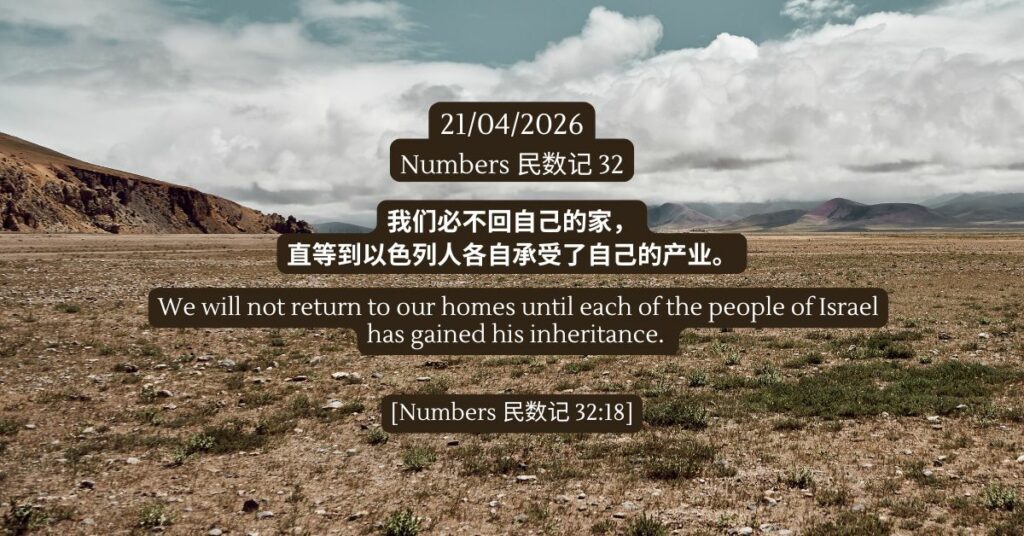
Numbers 32
We will not return to our homes until each of the people of Israel has gained his inheritance. – Numbers 32:18
Click to read passage
After God commanded Moses to bring judgment upon the Midianites (Numbers 31:2), the Israelites continued their journey toward the Promised Land that God had given them as their inheritance (Numbers 33:53). They knew clearly that their final destination was Canaan.
Among them, the tribes of Reuben and Gad had been greatly blessed by God with very large herds (v.1). As they journeyed, they saw the land of Jazer and Gilead, and recognised that it was suitable for livestock. These regions, located east of the Jordan River, were well-watered and ideal for grazing. For people with abundant livestock, it seemed like the perfect place—yet it lay outside the boundaries of the Promised Land (cf. Numbers 34:2–12).
So, they came to Moses, Eleazar the priest, and the leaders of the congregation and said, “The land that the LORD struck down before the congregation of Israel is a land for livestock, and your servants have livestock… Let this land be given to your servants for a possession. Do not take us across the Jordan” (vv.4–5).
“Do not take us across the Jordan”—this is a striking request. Did they not know that the Promised Land lay on the other side? How could they ask such a thing? Yet this reveals something very true of the human heart: what we see with our eyes can so easily cause us to forget what God has promised.
Their large herds were God’s blessing. The land they saw was also land that “the LORD struck down before the congregation of Israel” (v.4). The land met their needs perfectly. From a human perspective, everything seemed to align—surely this must be God’s provision, even God’s leading. Could there be any other interpretation? It all seemed so reasonable, even ideal.
But the answer is no. This passage challenges us to examine our hearts carefully as we discern God’s will. Are we truly submitting to God, or are we allowing our personal desires to shape our decisions? If we focus on God’s purposes rather than our own needs, we will remember that the destination has always been Canaan (cf. Genesis 17:8).
The land of Jazer and Gilead was like Elim, where there were “twelve springs of water and seventy palm trees” (Exodus 15:27)—a place of provision and rest along the journey. But it was never meant to be the destination. God did not intend for His people to settle there permanently. Yet these two tribes allowed their hearts to be captured by what they saw. They were satisfied with what seemed good, but missed what God had promised as best.
Moses immediately warned them by recalling the failure of the previous generation. Thirty-eight years earlier, ten spies had caused the people to lose heart because of what they saw (Numbers 13–14), and the entire generation fell in the wilderness (Numbers 14:32). Now, if these tribes chose comfort over obedience, they would once again discourage the whole nation (Numbers 32:7).
To their credit, these tribes responded differently from the previous generation. They did not remain stubborn, but were willing to listen, negotiate, and submit to Moses’ instruction. Moses agreed to their request, but only on the condition that they would first cross over and fight alongside the rest of Israel.
Even so, history later shows that their choice was short-sighted. The land they chose, though fertile, lacked natural defences. Centuries later, when Assyria invaded, these tribes were among the first to fall and be taken into exile. Their decision, shaped by immediate benefit, ultimately came at a great cost.
This passage speaks directly to us today. As we follow God, we too experience His blessings and provisions. Yet God’s intention is not for us to fix our eyes on the blessings, but on the Giver. He does not call us to settle for what is “good enough,” but to pursue what is best in Him. The question is: do we have the discernment to tell the difference?
Reflection:
In my journey with God, am I drawn more to what is immediately beneficial, or am I seeking what truly aligns with His will? Am I settling for what seems good, instead of pursuing what is best in Him?
Prayer:
Dear Heavenly Father, thank You for showing us, through the example of Reuben and Gad, that choices shaped by personal desire can have lasting consequences. What we see may bring temporary satisfaction, but it may not be Your best. Help us to fix our eyes not on what is before us, but on You. Grant us discernment to seek what is truly from You and give us hearts that are willing to trust and obey. In Jesus’ victorious name we pray, Amen.
Click to read passage
After God commanded Moses to bring judgment upon the Midianites (Numbers 31:2), the Israelites continued their journey toward the Promised Land that God had given them as their inheritance (Numbers 33:53). They knew clearly that their final destination was Canaan.
Among them, the tribes of Reuben and Gad had been greatly blessed by God with very large herds (v.1). As they journeyed, they saw the land of Jazer and Gilead, and recognised that it was suitable for livestock. These regions, located east of the Jordan River, were well-watered and ideal for grazing. For people with abundant livestock, it seemed like the perfect place—yet it lay outside the boundaries of the Promised Land (cf. Numbers 34:2–12).
So, they came to Moses, Eleazar the priest, and the leaders of the congregation and said, “The land that the LORD struck down before the congregation of Israel is a land for livestock, and your servants have livestock… Let this land be given to your servants for a possession. Do not take us across the Jordan” (vv.4–5).
“Do not take us across the Jordan”—this is a striking request. Did they not know that the Promised Land lay on the other side? How could they ask such a thing? Yet this reveals something very true of the human heart: what we see with our eyes can so easily cause us to forget what God has promised.
Their large herds were God’s blessing. The land they saw was also land that “the LORD struck down before the congregation of Israel” (v.4). The land met their needs perfectly. From a human perspective, everything seemed to align—surely this must be God’s provision, even God’s leading. Could there be any other interpretation? It all seemed so reasonable, even ideal.
But the answer is no. This passage challenges us to examine our hearts carefully as we discern God’s will. Are we truly submitting to God, or are we allowing our personal desires to shape our decisions? If we focus on God’s purposes rather than our own needs, we will remember that the destination has always been Canaan (cf. Genesis 17:8).
The land of Jazer and Gilead was like Elim, where there were “twelve springs of water and seventy palm trees” (Exodus 15:27)—a place of provision and rest along the journey. But it was never meant to be the destination. God did not intend for His people to settle there permanently. Yet these two tribes allowed their hearts to be captured by what they saw. They were satisfied with what seemed good, but missed what God had promised as best.
Moses immediately warned them by recalling the failure of the previous generation. Thirty-eight years earlier, ten spies had caused the people to lose heart because of what they saw (Numbers 13–14), and the entire generation fell in the wilderness (Numbers 14:32). Now, if these tribes chose comfort over obedience, they would once again discourage the whole nation (Numbers 32:7).
To their credit, these tribes responded differently from the previous generation. They did not remain stubborn, but were willing to listen, negotiate, and submit to Moses’ instruction. Moses agreed to their request, but only on the condition that they would first cross over and fight alongside the rest of Israel.
Even so, history later shows that their choice was short-sighted. The land they chose, though fertile, lacked natural defences. Centuries later, when Assyria invaded, these tribes were among the first to fall and be taken into exile. Their decision, shaped by immediate benefit, ultimately came at a great cost.
This passage speaks directly to us today. As we follow God, we too experience His blessings and provisions. Yet God’s intention is not for us to fix our eyes on the blessings, but on the Giver. He does not call us to settle for what is “good enough,” but to pursue what is best in Him. The question is: do we have the discernment to tell the difference?
Reflection:
In my journey with God, am I drawn more to what is immediately beneficial, or am I seeking what truly aligns with His will? Am I settling for what seems good, instead of pursuing what is best in Him?
Prayer:
Dear Heavenly Father, thank You for showing us, through the example of Reuben and Gad, that choices shaped by personal desire can have lasting consequences. What we see may bring temporary satisfaction, but it may not be Your best. Help us to fix our eyes not on what is before us, but on You. Grant us discernment to seek what is truly from You and give us hearts that are willing to trust and obey. In Jesus’ victorious name we pray, Amen.