
Numbers 9
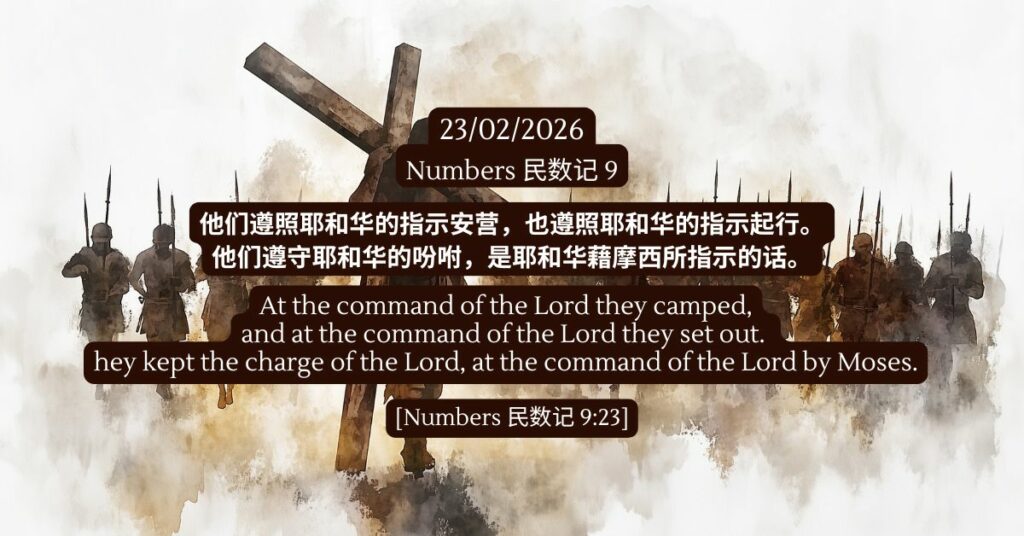
At the command of the Lord they camped, and at the command of the Lord they set out. They kept the charge of the Lord, at the command of the Lord by Moses. – Numbers 9:23
Click to read passage
Numbers 9 brings us back to the first month of the second year after the Exodus. The tabernacle had already been set up, and the people were camped around it. God instructed them to observe the Passover at the appointed time.
Passover was a festival remembering God’s deliverance from slavery in Egypt. Now, as they kept it for the second time in the wilderness, God was realigning their identity before they moved forward, reminding them that they were a redeemed people. God said, “The Israelites are to celebrate the Passover at the appointed time.” Worship was not to be random or casual. Spiritual life is shaped through rhythm, returning again and again to the starting point of salvation.
The passage highlights several men who became ceremonially unclean after touching a dead body and could not celebrate the feast on the fourteenth day of the first month. They did not quietly withdraw or dismiss the command; instead, they approached Moses and said, “Why should we be kept from presenting the LORD’s offering?” Their question reflected a longing for worship and a desire to draw near to God, even within their limitations.
Moses’ response is equally significant: “Wait until I find out what the LORD commands concerning you.” He did not rely on personal judgment but brought the matter before God. The LORD then established a provision for celebrating the Passover in the second month, while also making it clear that anyone who was ceremonially clean yet deliberately neglected the feast would bear the consequences. Here we see both God’s holiness and His mercy, His steadfast commands alongside His compassion for genuine weakness.
Today, do we still long for worship, or do we easily miss it when difficulties arise? When we cannot participate, is our heart still turned toward God? As God’s people, do we hold firmly to truth while also making space for others? In a long-established, multilingual, multicultural, multigenerational church, this balance is especially important. We must not become rigid because of tradition, nor compromise for the sake of convenience. We are called to both keep the feast and show compassion.
The focus then shifts to the cloud. On the day the tabernacle was set up, a cloud covered it, and at night it appeared like fire. The passage repeatedly emphasises: “Whenever the cloud lifted from above the tent, the Israelites set out; wherever the cloud settled, the Israelites camped.” Whether it was two days, a month, or a year, they “obeyed the LORD’s command.” This repetition is intentional, highlighting the discipline of obedience. The people could not predict when the cloud would move, nor determine how long they would stay. Their security did not come from a comfortable camp, but from God’s presence. Remaining required patience, moving required courage, and both required faith. We often want to know the full plan, yet God usually leads us step by step. Growth does not come from controlling the future, but from responding faithfully today. When God calls us to wait, do we become restless? When He calls us to move, do we hesitate? Passover teaches us to remember salvation, and the cloud teaches us to follow. Those who remember grace find it easier to obey, and those who obey experience God’s presence more deeply.
Reflection:
In my current life and ministry, am I truly guided by God’s command, or am I relying more on my own habits and plans?
Prayer:
Gracious God, You once guided Your people by a cloud. Guard my heart so that I may always remember Your salvation and not neglect Your commands. Whether staying or moving, grant me obedience and trust, that I may continue to grow as I walk with You. In the name of our Lord Jesus Christ, Amen.
Click to read passage
Numbers 9 brings us back to the first month of the second year after the Exodus. The tabernacle had already been set up, and the people were camped around it. God instructed them to observe the Passover at the appointed time.
Passover was a festival remembering God’s deliverance from slavery in Egypt. Now, as they kept it for the second time in the wilderness, God was realigning their identity before they moved forward, reminding them that they were a redeemed people. God said, “The Israelites are to celebrate the Passover at the appointed time.” Worship was not to be random or casual. Spiritual life is shaped through rhythm, returning again and again to the starting point of salvation.
The passage highlights several men who became ceremonially unclean after touching a dead body and could not celebrate the feast on the fourteenth day of the first month. They did not quietly withdraw or dismiss the command; instead, they approached Moses and said, “Why should we be kept from presenting the LORD’s offering?” Their question reflected a longing for worship and a desire to draw near to God, even within their limitations.
Moses’ response is equally significant: “Wait until I find out what the LORD commands concerning you.” He did not rely on personal judgment but brought the matter before God. The LORD then established a provision for celebrating the Passover in the second month, while also making it clear that anyone who was ceremonially clean yet deliberately neglected the feast would bear the consequences. Here we see both God’s holiness and His mercy, His steadfast commands alongside His compassion for genuine weakness.
Today, do we still long for worship, or do we easily miss it when difficulties arise? When we cannot participate, is our heart still turned toward God? As God’s people, do we hold firmly to truth while also making space for others? In a long-established, multilingual, multicultural, multigenerational church, this balance is especially important. We must not become rigid because of tradition, nor compromise for the sake of convenience. We are called to both keep the feast and show compassion.
The focus then shifts to the cloud. On the day the tabernacle was set up, a cloud covered it, and at night it appeared like fire. The passage repeatedly emphasises: “Whenever the cloud lifted from above the tent, the Israelites set out; wherever the cloud settled, the Israelites camped.” Whether it was two days, a month, or a year, they “obeyed the LORD’s command.” This repetition is intentional, highlighting the discipline of obedience. The people could not predict when the cloud would move, nor determine how long they would stay. Their security did not come from a comfortable camp, but from God’s presence. Remaining required patience, moving required courage, and both required faith. We often want to know the full plan, yet God usually leads us step by step. Growth does not come from controlling the future, but from responding faithfully today. When God calls us to wait, do we become restless? When He calls us to move, do we hesitate? Passover teaches us to remember salvation, and the cloud teaches us to follow. Those who remember grace find it easier to obey, and those who obey experience God’s presence more deeply.
Reflection:
In my current life and ministry, am I truly guided by God’s command, or am I relying more on my own habits and plans?
Prayer:
Gracious God, You once guided Your people by a cloud. Guard my heart so that I may always remember Your salvation and not neglect Your commands. Whether staying or moving, grant me obedience and trust, that I may continue to grow as I walk with You. In the name of our Lord Jesus Christ, Amen.