
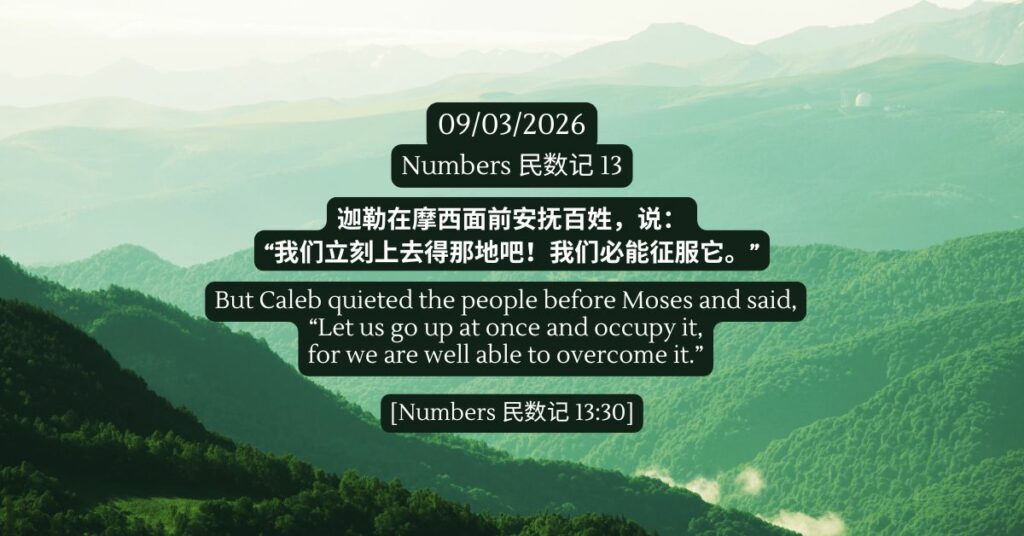
Numbers 13
But Caleb quieted the people before Moses and said, “Let us go up at once and occupy it, for we are well able to overcome it.” – Numbers 13:30
Click to read passage
The Israelites had arrived at the border of Canaan. The Promised Land lay before them. Moses sent twelve spies to explore the land. After forty days, they returned with astonishing evidence: the land truly flowed with milk and honey. A single cluster of grapes was so large that it had to be carried by two men. Everything God had said about the land was true.
However, the spies did not only report the goodness of the land. They also described the inhabitants as strong and tall, and the cities as large and fortified. Although these challenges were real, ten of the spies allowed fear to shape their conclusion: “We cannot attack those people; they are stronger than we are.” They even said, “We seemed like grasshoppers in our own eyes.”
The issue was not merely that they were afraid, but how they viewed themselves and how they viewed God.
Looking at the same giants, Caleb responded differently: “We should go up and take possession of the land, for we can certainly do it.” He was not denying the difficulties. Instead, he evaluated reality through the lens of God’s promise.
Why did the Israelites, who had experienced God’s deliverance, provision, and discipline in the wilderness, still have such little faith?
In truth, we are often the same. We are familiar with God’s works and have experienced His guidance over the years. He has provided for us in hardship, opened paths when we were uncertain, and sustained us in our weakness. Yet when new challenges arise, our hearts can quickly be filled with anxiety again.
Why do we still become so afraid?
Often, our fear does not arise because God is unfaithful, but because our hearts are accustomed to relying on ourselves. We first calculate resources, abilities, and risks, and only afterwards think of God. Once a situation moves beyond our control, our hearts begin to grow uneasy.
The perspective of the ten spies reflects this pattern: they first looked at the difficulty, then at themselves, and eventually almost lost sight of God altogether. The deepest root of fear is often that we magnify our circumstances while diminishing God.
Growing in faith does not mean denying difficulties. It means learning to adjust our perspective. The real question is not, “How big are the giants?” but “How great is God? Do I still trust His promises?”
Perhaps you are facing a “giant” right now: pressure at work, challenges in your family, health concerns, or uncertainty about the future. Today, God’s Word reminds us not to let circumstances alone define reality, but to allow God’s promises to reshape our perspective and renew our faith.
Often, the renewal of faith begins with a simple and honest prayer: “Lord, I admit that I am afraid, but I choose to trust Your Word again.”
Reflection:
What is the one thing that has caused you the most anxiety recently? Have you been measuring it only by your own ability, instead of truly entrusting it to God?
Prayer:
Lord, You are a faithful God. Many times, I see my circumstances more clearly than I see Your promises, and I am easily controlled by fear. Please shine Your light on my heart and reveal where I have relied on myself and struggled with unbelief. Renew my perspective so that I may trust Your Word again. Even when I am weak, You remain faithful. Help me to choose to trust You each day. In Jesus’ name I pray, Amen.
Click to read passage
The Israelites had arrived at the border of Canaan. The Promised Land lay before them. Moses sent twelve spies to explore the land. After forty days, they returned with astonishing evidence: the land truly flowed with milk and honey. A single cluster of grapes was so large that it had to be carried by two men. Everything God had said about the land was true.
However, the spies did not only report the goodness of the land. They also described the inhabitants as strong and tall, and the cities as large and fortified. Although these challenges were real, ten of the spies allowed fear to shape their conclusion: “We cannot attack those people; they are stronger than we are.” They even said, “We seemed like grasshoppers in our own eyes.”
The issue was not merely that they were afraid, but how they viewed themselves and how they viewed God.
Looking at the same giants, Caleb responded differently: “We should go up and take possession of the land, for we can certainly do it.” He was not denying the difficulties. Instead, he evaluated reality through the lens of God’s promise.
Why did the Israelites, who had experienced God’s deliverance, provision, and discipline in the wilderness, still have such little faith?
In truth, we are often the same. We are familiar with God’s works and have experienced His guidance over the years. He has provided for us in hardship, opened paths when we were uncertain, and sustained us in our weakness. Yet when new challenges arise, our hearts can quickly be filled with anxiety again.
Why do we still become so afraid?
Often, our fear does not arise because God is unfaithful, but because our hearts are accustomed to relying on ourselves. We first calculate resources, abilities, and risks, and only afterwards think of God. Once a situation moves beyond our control, our hearts begin to grow uneasy.
The perspective of the ten spies reflects this pattern: they first looked at the difficulty, then at themselves, and eventually almost lost sight of God altogether. The deepest root of fear is often that we magnify our circumstances while diminishing God.
Growing in faith does not mean denying difficulties. It means learning to adjust our perspective. The real question is not, “How big are the giants?” but “How great is God? Do I still trust His promises?”
Perhaps you are facing a “giant” right now: pressure at work, challenges in your family, health concerns, or uncertainty about the future. Today, God’s Word reminds us not to let circumstances alone define reality, but to allow God’s promises to reshape our perspective and renew our faith.
Often, the renewal of faith begins with a simple and honest prayer: “Lord, I admit that I am afraid, but I choose to trust Your Word again.”
Reflection:
What is the one thing that has caused you the most anxiety recently? Have you been measuring it only by your own ability, instead of truly entrusting it to God?
Prayer:
Lord, You are a faithful God. Many times, I see my circumstances more clearly than I see Your promises, and I am easily controlled by fear. Please shine Your light on my heart and reveal where I have relied on myself and struggled with unbelief. Renew my perspective so that I may trust Your Word again. Even when I am weak, You remain faithful. Help me to choose to trust You each day. In Jesus’ name I pray, Amen.