
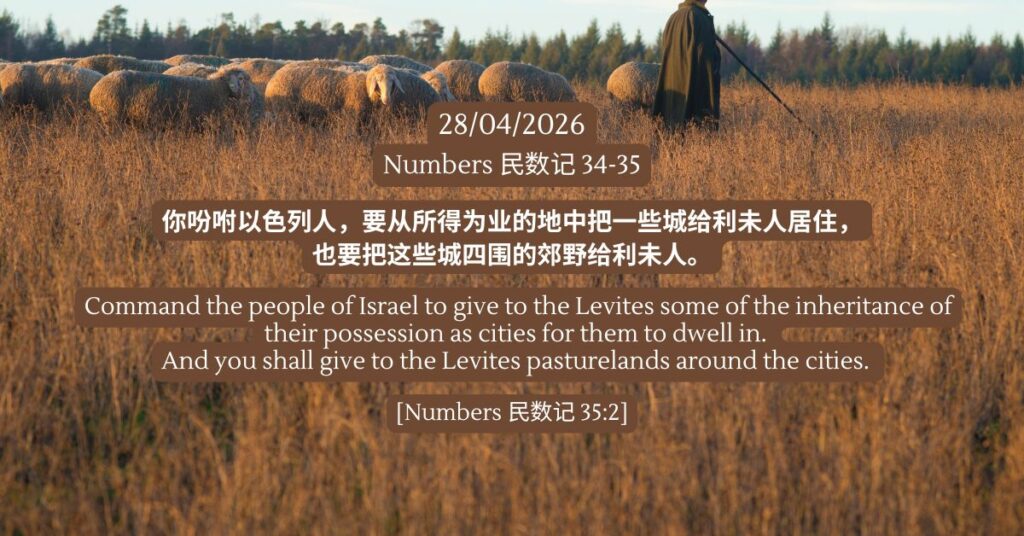
Numbers 34-35
Command the people of Israel to give to the Levites some of the inheritance of their possession as cities for them to dwell in. And you shall give to the Levites pasturelands around the cities. – Numbers 35:2
Click to read passage
As we come to the final three chapters of Numbers, we may feel, like the new generation of Israelites, that the story is reaching its climax. The years of judgment and hardship are behind them. After forty years in the wilderness, they are ready to enter Canaan, to take possession of the land, and perhaps even imagine decisive victory ahead.
Yet at this moment, everything pauses. Before they enter, God gives detailed instructions, defining the boundaries of the land and establishing laws that will govern their life there.
The establishment of the cities of refuge marks an important turning point. For Israel, entering Canaan meant moving from a nomadic people into a settled community shaped by God’s laws and justice.
The term “city of refuge” carries the idea of a shelter or place of protection. It was designated for those who had killed someone unintentionally (v.6), providing safety from the avenger of blood “until he stands before the congregation for judgment” (v.12). The passage carefully distinguishes between murder and manslaughter, and requires the testimony of multiple witnesses. All this shows how deeply God values human life.
The arrangement of these cities also highlights God’s purpose for the Levites. Unlike the other tribes, the Levites were not given a territorial inheritance. Instead, God commanded that cities be set aside for them from among the tribes (v.1), so that they would be spread throughout the land. In this way, they could continually teach God’s laws to the people.
Among the forty-eight Levitical cities, six were appointed as cities of refuge (v.6). These were not only for the Israelites, but also for the foreigner and the sojourner among them (v.15). From the time God called Abraham, His intention has always been that His people would be a blessing to all nations.
The cities of refuge reveal both God’s justice and His mercy. His justice is seen in that the guilty are not treated as innocent, but intentional murder is to be punished (vv.16–21). His mercy is seen in that those who kill unintentionally are given a place of safety, protected from revenge.
These cities also point forward to Christ. They foreshadow the refuge we have in Jesus, who provides us with safety and salvation. In our lives, we have sinned against God and against others. Yet through Christ, we are given a place of refuge. By coming to Him, we receive new life, just as the one who fled to the city of refuge was spared.
Reflection:
The apostle Paul says, “By the grace of God I am what I am” (1 Corinthians 15:10). Can you recall a moment in your life when Christ’s love rescued you from sin? How can you cherish this new life in Christ and share His love with others who are still in need of rescue?
Prayer:
Lord Jesus, thank You for being my refuge and my strong rock. Even when life is filled with challenges and difficulties, I find peace and joy in You. Help me to treasure this grace, and to invite others to come to You, so that they too may find true rest. In Jesus’ name we pray, Amen.
Click to read passage
As we come to the final three chapters of Numbers, we may feel, like the new generation of Israelites, that the story is reaching its climax. The years of judgment and hardship are behind them. After forty years in the wilderness, they are ready to enter Canaan, to take possession of the land, and perhaps even imagine decisive victory ahead.
Yet at this moment, everything pauses. Before they enter, God gives detailed instructions, defining the boundaries of the land and establishing laws that will govern their life there.
The establishment of the cities of refuge marks an important turning point. For Israel, entering Canaan meant moving from a nomadic people into a settled community shaped by God’s laws and justice.
The term “city of refuge” carries the idea of a shelter or place of protection. It was designated for those who had killed someone unintentionally (v.6), providing safety from the avenger of blood “until he stands before the congregation for judgment” (v.12). The passage carefully distinguishes between murder and manslaughter, and requires the testimony of multiple witnesses. All this shows how deeply God values human life.
The arrangement of these cities also highlights God’s purpose for the Levites. Unlike the other tribes, the Levites were not given a territorial inheritance. Instead, God commanded that cities be set aside for them from among the tribes (v.1), so that they would be spread throughout the land. In this way, they could continually teach God’s laws to the people.
Among the forty-eight Levitical cities, six were appointed as cities of refuge (v.6). These were not only for the Israelites, but also for the foreigner and the sojourner among them (v.15). From the time God called Abraham, His intention has always been that His people would be a blessing to all nations.
The cities of refuge reveal both God’s justice and His mercy. His justice is seen in that the guilty are not treated as innocent, but intentional murder is to be punished (vv.16–21). His mercy is seen in that those who kill unintentionally are given a place of safety, protected from revenge.
These cities also point forward to Christ. They foreshadow the refuge we have in Jesus, who provides us with safety and salvation. In our lives, we have sinned against God and against others. Yet through Christ, we are given a place of refuge. By coming to Him, we receive new life, just as the one who fled to the city of refuge was spared.
Reflection:
The apostle Paul says, “By the grace of God I am what I am” (1 Corinthians 15:10). Can you recall a moment in your life when Christ’s love rescued you from sin? How can you cherish this new life in Christ and share His love with others who are still in need of rescue?
Prayer:
Lord Jesus, thank You for being my refuge and my strong rock. Even when life is filled with challenges and difficulties, I find peace and joy in You. Help me to treasure this grace, and to invite others to come to You, so that they too may find true rest. In Jesus’ name we pray, Amen.